
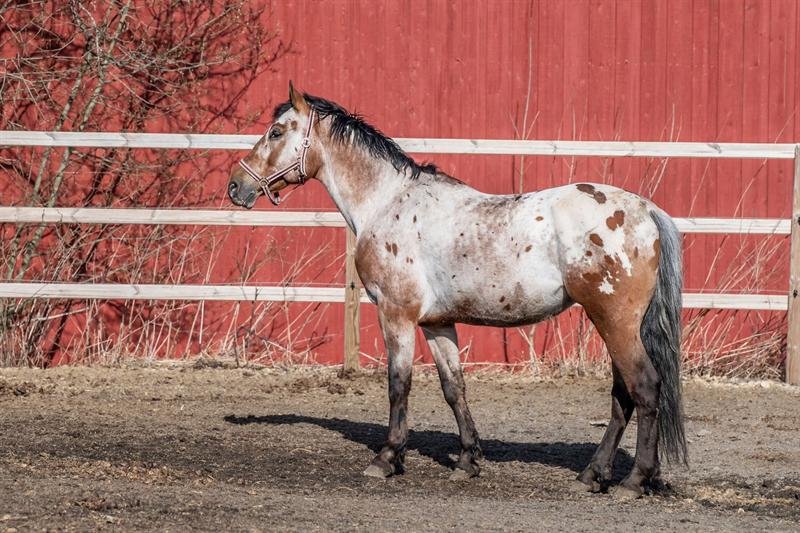
The Appaloosa horse is the spotted horse of the American West, loved for its dramatic coat patterns and versatile, steady nature. It makes an eye-catching leisure and western horse, but it has a few particular health points, especially eyesight, that buyers should understand.
| At a glance | |
|---|---|
| Height | 14.2 to 16 hands |
| Typical weight | Roughly 450 to 550 kg |
| Temperament | Willing, intelligent, steady, friendly |
| Common colours | Leopard, blanket, snowflake, marble, varnish roan and solid with Appaloosa characteristics |
| Best for | Western riding, trail riding, all-round leisure, showing |
| Origin | North America, developed by the Nez Perce people |
Appaloosa history
Spotted horses appear in ancient art across the world, but the modern Appaloosa was developed by the Nez Perce people of the north-western United States, who bred horses for stamina, intelligence and colour. After conflict in the 1870s the breed nearly vanished, and a breed club formed in 1938 to preserve it. In the UK, the British Appaloosa Society promotes the breed.
Appaloosa coat patterns
The coat is the breed's trademark. Appaloosa coat patterns are linked to the leopard complex gene, and several recognised patterns exist, which can be combined with different base colours. The main ones are:
| Pattern | What it looks like |
|---|---|
| Leopard | White coat covered with dark spots |
| Blanket | A white area over the hips or body, with or without spots |
| Snowflake | White spots on a dark coat |
| Marble | Mottled, roan-like colouring that changes with age |
| Varnish roan | Roan-like coat with darker areas over bony points such as the face and legs |
Many Appaloosas also show other characteristic features: mottled skin around the muzzle and eyes, a visible white sclera around the eye, striped hooves, and a sparse mane and tail. Patterns can change as the horse ages, and foals often look different from adults.
Appaloosa temperament
Appaloosa temperament is typically willing, intelligent and friendly. Many are steady and sensible on a trail, quick to learn and good all-rounders, which suits western riding, leisure riding and showing. They tend to bond closely with people, but as with any breed, individuals vary a lot, and some are sensitive or strong-minded. Fair, consistent training suits them well.
Appaloosa health: eyes, uveitis and night blindness
Appaloosas have a few health points that buyers and owners should understand, and the eyes are the main one. Always discuss specifics with your vet; the points below are general information.
- Equine recurrent uveitis (ERU): inflammation inside the eye that comes and goes, sometimes called "moon blindness". Appaloosas are reported to be at higher risk than many other breeds. Repeated episodes can damage the eye and, in some cases, lead to vision loss. Appaloosa uveitis needs veterinary diagnosis and treatment.
- Congenital stationary night blindness (CSNB): research links this condition to horses that carry two copies of the leopard complex gene, which are usually the heavily patterned "few-spot" leopards. Affected horses may have reduced vision in low light, and they may be more anxious or reluctant in dim conditions. It is thought to be non-progressive. A genetic test exists, and your vet can advise if testing is useful.
- Skin and sun: pink or mottled skin can be more sensitive to sunburn, particularly on the muzzle, so shade, fly masks with nose protection or sun-safe measures may be advisable. See skin conditions and eye problems for more.
- Feet and legs: striped hooves are normal, and feet can be good, though conformation varies and the breed is not exempt from lameness.
Appaloosa care guide
Appaloosa care is similar to other leisure horses, with a few extras. Keep up routine vaccinations, dental care and worm management. Protect pale skin from the sun and watch for rubbing and sensitivity, particularly with sparse tails; some Appaloosas are also affected by sweet itch. Check eyes daily as part of your usual routine, looking for discharge, cloudiness or squinting. Have feet trimmed regularly by a farrier registered with the Farriers Registration Council. Adjust rides and hacking times if your horse seems less confident at dusk.
Appaloosa horse for sale in the UK
When looking at an Appaloosa horse for sale in the UK, the colour can be tempting, but do not let it distract from soundness and training. Check:
- Eyes: ask about any history of cloudiness, treatment or squinting, and have the eyes examined at the vetting.
- Night vision: ask whether the horse is confident in low light, and consider genetic testing if the pattern suggests it.
- Training and temperament: see the horse ridden by more than one person.
- Papers: passport, microchip and breed registration, as required by DEFRA rules.
- Insurance: eye conditions can affect cover, so read the terms carefully (see insurance).
Prices vary widely with age, training, quality and region. Compare several horses and use the buying checklist to stay organised.
Training and riding an Appaloosa
Appaloosas are intelligent and usually learn quickly, which is a strength in training but means they notice inconsistency. Start with calm groundwork, build trust and keep sessions varied. Many do well in western training because their natural steadiness suits trail work, reining and ranch-style classes, and they also adapt happily to English tack for hacking and local shows. See our guides to groundwork and western riding.
If your horse has any vision problems, take extra care. Introduce new places, jumps or obstacles slowly, give the horse time to look, and avoid riding at dusk if it is unsure in low light. A horse with limited vision in one eye will often need a handler who approaches from the side it can see and speaks as they come close. Many horses with reduced vision cope very well with calm handling and a predictable routine, but you should always take your vet's advice about safety and suitability for riding.
Is an Appaloosa a good choice for you?
The Appaloosa suits an owner who wants a friendly, versatile all-rounder and is prepared to stay on top of eye checks and sun protection. It is less ideal if you want to avoid the possibility of ongoing veterinary costs for an eye condition. Before buying, discuss the horse's eye history with your vet, check how an insurer treats eye conditions, and decide how much risk you are comfortable with. Many Appaloosas live long, healthy, active lives, and with attentive care the breed makes a rewarding and distinctive partner. If you are choosing between breeds, our quarter horse guide covers another popular western type.
FAQs
Are Appaloosas prone to uveitis?
They are reported to be at higher risk of equine recurrent uveitis than many other breeds. Any eye changes need a vet's assessment.
Do all Appaloosas have night blindness?
No. It is linked to horses that carry two copies of the leopard complex gene, not every Appaloosa. A vet can advise on testing.
What are the Appaloosa coat patterns?
Leopard, blanket, snowflake, marble and varnish roan are the main ones, and some horses are solid-coloured with other Appaloosa characteristics.
Are Appaloosas good for beginners?
Many are steady and willing, but a beginner should choose an individual that is well schooled and confident, with the right instruction.
What is an Appaloosa used for?
Western and trail riding, all-round leisure riding and showing are the most common uses.
How tall is an Appaloosa?
Typically about 14.2 to 16 hands.
Useful official resources
- The British Horse Society Owning and caring for horses of every type.
- World Horse Welfare Rehoming and welfare charity.