
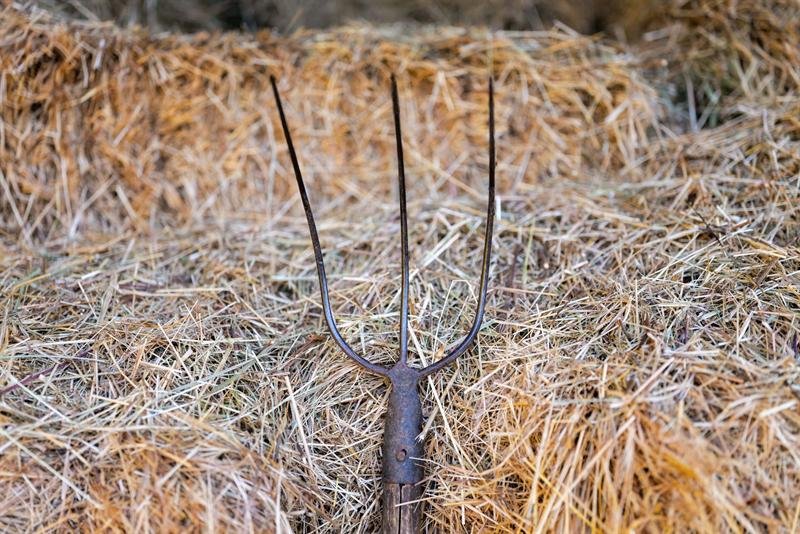
The best horse bedding is the one that keeps your horse comfortable and healthy, suits your time and budget, and can be disposed of sensibly afterwards. For a horse with respiratory sensitivity, dust-free horse bedding matters most; for a horse that eats its bed, shavings or paper are often safer than straw. Whatever you choose, how well you manage it counts for more than the material itself.
Horse bedding types compared
There is no single best bedding for horses, because each type trades off dust, absorbency, cost, storage and disposal differently. The table below summarises the main horse bedding types used on UK yards.
| Type | Pros | Cons |
|---|---|---|
| Wheat straw | Cheap, widely available, warm and good for deep beds; muck usually rots down well and is often wanted by local farmers or gardeners | Can be dusty and carry fungal spores; horses may eat it; bulky to store and handle |
| Wood shavings | Low dust if well produced, easy to skip out, tidy appearance | Cost varies; can be heavy when wet; slow to rot down, and disposal can be an issue |
| Hemp | Highly absorbent and low in dust; a bed can last well | Higher initial cost; availability varies by area |
| Flax (linen) | Absorbent, low in dust, fairly light to handle | Can be damp and sticky; some horses find it unfamiliar |
| Shredded paper | Low dust, suits allergy-prone and straw-eating horses, often cheap | Can be heavy when wet; may blow around; drainage can be poor |
| Wood pellets | Compact to store, absorbent once wetted | Need correct wetting to expand; can be dusty if not; some horses dislike the texture |
| Rubber mats with a thin bed | Reduces bedding use and saves money; see rubber mats | Needs good management of wet areas |
Shavings vs straw
This is the comparison most owners ask about. Straw is warm, natural and usually the cheapest to buy, and many horses like it. Its drawbacks are dust and fungal spores, particularly in poorer-quality or damp-stored bales, and the fact that a greedy horse may eat a lot of it. Shavings are generally lower in dust and quicker to muck out, but a bag of shavings is bulkier to dispose of, and muck heaps of shavings take longer to break down than straw.
If your horse has a cough, a history of respiratory problems, or lives in a stable with poor airflow, most owners and vets would steer you towards a low-dust alternative. If your horse is a confirmed straw-eater or is prone to weight problems, a non-edible bed such as shavings or paper may be the better choice. Always take your vet's advice for an individual horse.
Best bedding for horses with dust allergies
For horses with allergic or inflammatory airway disease, the aim is to cut how much dust and mould spores they breathe in overnight. Dust-extracted shavings, hemp, flax and paper are all commonly chosen, but none helps much if the rest of the stable environment is dusty. Wet or steam the hay, keep forage off the floor, and make sure the stable is well ventilated; see stable ventilation. Avoid shaking out beds with the horse inside the stable.
Bedding systems and how deep to bed
- Daily muck out: remove droppings and wet every day, shake up and rebuild the bed. It takes more time but suits most yards and gives you the freshest bed.
- Semi-deep litter: remove droppings and wet patches daily, then strip the bed fully at intervals that depend on the material.
- Deep litter: builds a deep bed over weeks. It is not recommended for horses with respiratory conditions, because ammonia and microbes can build up.
A good bed should be deep enough that the horse cannot feel the floor when lying down, with banked sides to give comfort and to reduce the risk of the horse becoming cast against a wall. Cover the whole floor thickly, particularly if there is no matting. As a rough guide, a typical stable around 12ft x 12ft needs far more bedding for a full bed than for a day-to-day top-up, so costs differ widely between a full bed and a thin bed over mats.
How to muck out step by step
- Remove or tie up the horse, and take out water buckets and feeders.
- Pick out droppings into a barrow and remove any wet or heavily soiled bedding.
- Bank clean bedding to the walls and sweep or scrape the floor you have exposed.
- Let the floor dry or air for a while where possible, especially if you use mats.
- Spread clean bedding back across the floor, add fresh as needed and bank the sides.
- Refill buckets and tidy the stable before the horse returns.
More detail on routines is in stable cleaning and stable hygiene.
Cost, storage and muck disposal
Bedding is one of the larger regular costs of keeping a horse at home, and prices vary by region, supplier and time of year, so compare the real cost per week rather than the price per bag. A material that costs more per bag but lasts longer, or needs less skipping out, can work out cheaper. Store bedding dry and off the ground, ideally away from the stables to cut fire risk.
Disposal is easy to overlook. Straw muck is often taken by farmers or mushroom growers; shavings and some other materials can be harder to place. Check whether your yard, the local council or a muck collection service will accept your bedding before you commit. Muck heaps must be sited and managed so run-off does not reach watercourses.
What to look for when buying
- Dust level: look for dust-extracted products, and check by shaking a handful in good light.
- Absorbency and how long a bag lasts in practice, not just the price per bag.
- Bag size and storage space; storage should be dry and off the ground.
- Disposal: ask how used bedding rots down and whether local muck removal accepts it.
- Suitability for your horse: allergies, straw-eating, or foot and leg conditions.
- Source and quality: check for mould, strong smells or foreign matter. Avoid shavings made from treated timber, which may be harmful.
- Delivery options and whether you can buy in bulk without wasting stock.
FAQs
What bedding is best for horses with allergies?
Low-dust types such as hemp, paper or well-extracted shavings are commonly chosen, together with good ventilation and soaked or steamed forage. Take advice from your vet.
Is straw or shavings better for horses?
Neither is better for every horse. Straw is cheap and warm but dustier and edible; shavings are lower in dust but can be costlier and harder to dispose of.
How much bedding do I need?
Quantities vary hugely by material, horse and system. Start with a full cover across the floor and adjust to what keeps the bed clean and comfortable.
Can I use sawdust?
Fine sawdust is generally not recommended, as it can be dusty and may come from treated or unsuitable wood.
How often should I change horse bedding?
Droppings and wet patches should come out daily. How often a full strip-out is needed depends on the material and system; a daily full muck out suits most horses.
Do I still need bedding if I have rubber mats?
Yes. A bed is still needed for comfort and to absorb urine, though it can be thinner than on bare concrete.
Useful official resources
- Code of Practice for the Welfare of Horses (gov.uk) Legal standards for shelter, space and care.
- Ragwort code of practice (gov.uk) How to control ragwort on your land.
- British Horse Society: horse care and welfare Yard and grazing advice.