
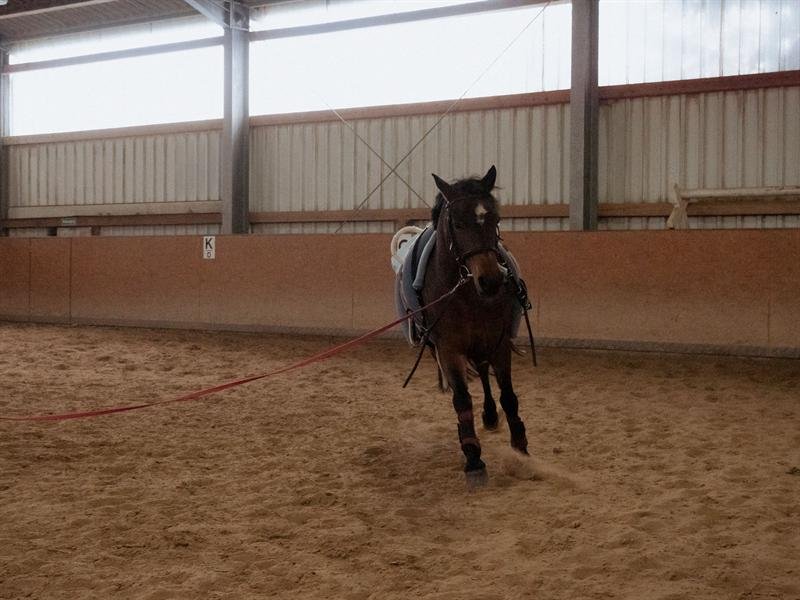
How to lunge a horse comes down to working him in a circle around you on a long line, with clear body language and a calm voice. Done well, it provides exercise, teaches voice aids and balance and lets you watch your horse move; done badly, it strains joints and teaches nothing. Keep circles large, sessions short and the horse relaxed.
What is lunging for?
Lunging has several genuine uses: letting a fresh horse settle, teaching voice commands and transitions, introducing a young horse to work, exercising a horse that cannot be ridden for a short time, and assessing how a horse moves. It is not a way to wear out a horse that has had too little turnout, and it is not a replacement for ridden work. If a horse needs to be lunged to be safe to ride every day, look at his routine, feeding and turnout first; see daily care.
Lunging equipment
- Lunge cavesson or a well-fitted bridle: a cavesson spreads pressure across the nose and avoids interfering with the mouth. If you attach the line to a bridle, a headcollar or cavesson over the top is often kinder to the mouth. Check that the fit is secure and that nothing can slip.
- Lunge line: about eight metres, lightweight and non-slip, preferably with a swivel. Webbing and cotton are common.
- Lunge whip: used as an extension of your arm and voice, not for hitting.
- Boots or bandages: consider protection for the legs; see horse boots.
- Gloves, hat and sturdy boots: for you. Gloves prevent rope burn; a hat that meets a current standard, such as PAS 015 or VG1 01.040, protects you if the horse bucks or pulls away.
Use an enclosed area with good, level, non-slippery footing, ideally an arena or a round pen. Avoid hard, deep or uneven ground and areas with open gates. Remove clutter, check fencing and make sure other horses cannot run over to join in.
Lunge line technique, step by step
- Prepare: check the horse is sound, comfortable and wearing correct tack. Hold the line in neat loops in your hand, never wrapped around your fingers, wrist or body. Allow the horse to see and become used to the whip.
- Start in walk: stand roughly in the middle, forming a triangle between you, the horse's head and his hindquarters. Your whip hand points to the hindquarters, and your line hand to the head.
- Use voice and body language: ask for trot with a clear "and trot" and a lift of the whip; ask for walk with a lowered voice and a relaxed posture. Use the same words each time.
- Keep the circle large: see circle size below. Move on a small circle yourself, turning with the horse.
- Keep a soft contact: a gentle, elastic feel in the line. Do not pull, jerk or hang on to it.
- Change the rein often: every few minutes, to work both sides evenly. Halt, walk to the horse and change; do not throw the line across his back.
- Finish with walk and a stretch, and let the horse cool down before leading him in.
Reading your horse on the circle
Lunging is one of the best ways to watch your horse move, so use it. Look for an even, regular rhythm in each pace, a relaxed back and neck, and soft, willing transitions. Signs of tension include a raised head, a hollow back, rushing, a swishing tail or repeatedly bolting off. If you see them, go back to walk, make the circle larger and ask for less. Always finish on a calm, correct transition so the last memory of the session is a good one.
Lunging circle size
The size of the circle matters as much as anything. A circle that is too small puts strain on the joints and tendons, particularly in young horses, and encourages the horse to fall in. Aim for a circle of roughly 15 to 20 metres in diameter, with the lunge line an average of eight metres long. Your eye will soon tell you if the horse is going on a tight circle. If your arena is small, work in walk and trot only, and take time over transitions.
How long to lunge a horse
| Purpose | Notes |
|---|---|
| Exercise or settling a fresh horse | Ten to twenty minutes, with plenty of walk and trot |
| Teaching voice commands | Short sessions; repeat transitions until prompt |
| Young horses | Brief sessions, around ten minutes; avoid repeated tight circles and canter work until strong |
| Assessing movement | Watch for unevenness; see a vet if you suspect lameness |
| Older or stiff horses | Gentle, short, mostly walk and trot, and check with your vet |
For most horses, about 15 to 20 minutes including walking is plenty, and a couple of sessions a week alongside other work is enough. Lunging is hard on the horse if overdone, so avoid long sessions, and keep canter on a large circle and for short stretches, with equal time on each rein.
Lunging for beginners: common mistakes
- Circles that are too small, or letting the horse spiral in and out.
- Standing still and chasing with the whip. Instead, use your body position and a light, calm voice.
- Too long, too often, which tires and sours the horse.
- Letting the horse charge round without asking for balanced transitions.
- Using gadgets without guidance: side reins and training aids can create tension if misused, so use them only with an experienced trainer.
- Poor handler safety: loose line around the hand, no hat or gloves, or loose coils on the ground.
When not to lunge
Skip it if the horse is lame, sore or unwell, if the footing is poor or frozen, or if your horse is highly strung and you have not yet taught him to be calm on the ground. See groundwork first. Do not lunge soon after a big meal or when a horse is exhausted. Young horses and those recovering from injury need advice from a vet and an experienced trainer.
Lunging safely
Most accidents come from lines wrapping around hands or feet, horses pulling away, and handlers being kicked or run over. Keep the line in neat loops, never in a knot or wrapped, stand clear of the horse's hindquarters and wear gloves and a hat. If a horse gets loose, let go of the line rather than being dragged. Keep the arena gate shut and have a helper if the horse is fresh.
FAQs
Can I lunge every day?
It is better to vary work and avoid daily lunging on small circles. A couple of sessions a week alongside other work is plenty for most horses.
Is lunging good for fitness?
It offers some, but ridden work in straight lines and on hills will usually build fitness better and with less joint strain.
What size circle should I lunge on?
Aim for around 15 to 20 metres in diameter. Smaller circles put more strain on joints, particularly for young horses.
Should I lunge a horse before riding?
Occasionally, for a fresh horse, but it should not be a habit. A longer warm-up in walk under saddle, more turnout and sensible feeding are better long-term answers.
Can I lunge a horse in a headcollar?
A well-fitting lunge cavesson or bridle is better, as a headcollar can slip and put pressure in the wrong places. A rope headcollar is not suitable.
How do I teach a horse to lunge?
Start with good groundwork, then introduce the line, whip and voice commands in a small enclosed area, with a helper, in short, calm sessions.
Useful official resources
- The British Horse Society Training, coaching and qualifications.
- World Horse Welfare: advice Handling and welfare guidance.