
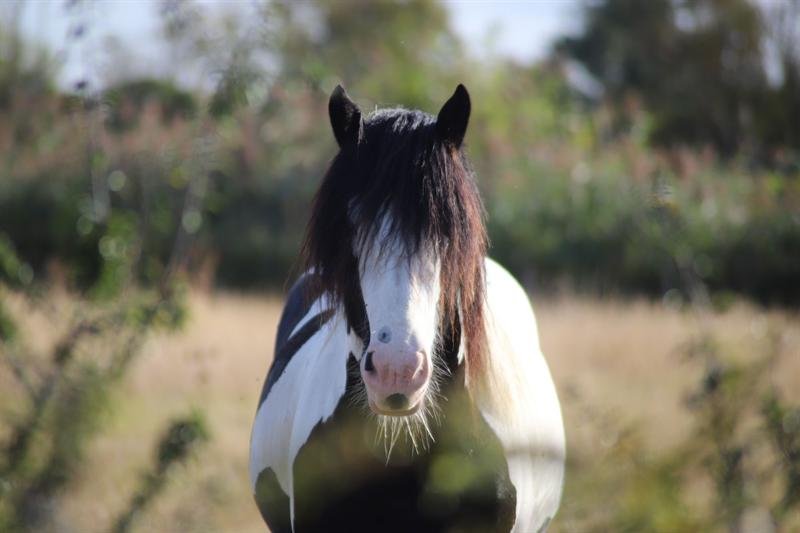
A cob horse is a short-legged, stocky, strong horse with a kind head and a comfortable stride. In the UK "cob" describes a type rather than a registered breed, and its calm, sensible reputation makes it a favourite for nervous riders, heavier riders and returning adults.
| At a glance | |
|---|---|
| Height | Typically 14 to 15.3 hands (show cobs up to 15.3 hh) |
| Typical weight | Roughly 450 to 600 kg |
| Temperament | Calm, sensible, laid-back, tolerant |
| Common colours | Any, including bay, black, piebald, skewbald and dun |
| Best for | Heavier riders, nervous or returning riders, hacking, driving |
| Origin | British Isles |
What is a cob horse?
The word cob has been used for centuries for a sturdy, short-legged riding horse suited to carrying a rider over long distances in comfort. Today it describes a build rather than a pedigree: a deep, broad body, a short strong back, good bone, a short neck and a calm expression. Cobs developed from native and draught blood, and "Irish cobs" in particular became popular in the UK and beyond.
Because it is a type, two horses sold as cobs can look and behave quite differently. Some are registered with breed or type societies, many are not, and the label tells you far less than the individual horse in front of you. Do not confuse the type with the Welsh Cob (Section D), which is a registered breed: see our guide to the Welsh Pony and Cob.
Cob horse height and build
Most cobs stand between about 14 and 15.3 hands. Show cobs are capped at 15.3 hh in the ring, while many pleasure cobs are smaller and a few are bigger. The build is more important than the measuring stick: a good cob has a deep girth, strong hindquarters, short cannon bones and often a little feather on the heels. Many are cross-bred with a touch of Shire, Clydesdale, Irish Draught or Thoroughbred blood, which affects both size and sensitivity. A cob with some Thoroughbred in it may be livelier than the traditional picture suggests.
Cob horse temperament
Cobs are known for a quiet, sensible attitude, though that does not mean lazy. Many are bold and sociable and can be spirited when fresh. They tend to be tolerant of rider mistakes, which suits novice and returning riders, and many have the stamina and balance for a long, relaxed hack. Some are strong-willed and will take advantage of a soft handler, so consistent, fair training matters. A cob that is "easy" is usually easy because of how it was brought up, so ask about its history.
What are cobs used for?
- Relaxed hacking and trekking.
- Riding school and novice mounts.
- Showing in cob classes, ridden and in hand.
- Carriage driving.
- Heavier riders who need weight-carrying capacity.
- Lower-level dressage, working equitation and riding club activities. See our riding club guide.
Show cobs are a recognised class in British showing, with a traditional hogged (clipped) mane and a stocky, workmanlike outline. See showing for how classes work.
Cob laminitis and other health issues
Weight is the biggest challenge. Cobs are easy keepers prone to obesity, insulin dysregulation and laminitis, so cob laminitis is a very common worry for owners. Watch for a cresty neck, fat pads over the rump and behind the shoulder, and a horse that is "good-doing" on very little. Foot soreness, a bounding digital pulse or a reluctance to turn on hard ground need prompt veterinary attention.
Other things to know about:
- Feather: heavily feathered legs are prone to mud fever and mites, so check legs daily.
- Skin: sweet itch and other skin conditions are common in native-type cobs.
- Joints: overweight cobs put extra load on their joints, so condition control protects soundness.
- Older age: native-type cobs can develop PPID (Cushing's) in later life, which your vet can test for.
Daily care guide
- Grazing: restrict fresh grass and use strip grazing, a track system or a grazing muzzle where needed. See pasture care.
- Feeding: mostly forage, with a vitamin and mineral balancer, rather than hard feed. Weigh hay rather than guessing. See our weight loss guide.
- Exercise: regular work keeps weight down; turnout alone usually is not enough.
- Feather: keep it clean and dry, and avoid over-washing, which can leave skin damp.
- Tack: broad backs and rounded barrels need properly fitting saddles and long enough girths. See saddles.
- Rugs: many cobs are warm-blooded for their size, so avoid over-rugging, which adds to weight and heat.
Showing and keeping a cob fit
A cob in work needs a sensible fitness plan. Start with walking on varied ground to build strength gently, add trot and canter as fitness improves, and use hills and poles to tone muscle without pounding joints. Cobs that are overweight need steady, regular exercise rather than occasional hard days. If you plan to show, practise plaiting or hogging, trotting up in hand and standing square, and ask an experienced exhibitor for advice. A cob in the ring should look fit and well muscled, not fat, and judges increasingly reward correct condition.
Cob horse for sale in the UK: buying advice
Because "cob" is not a breed, check what you are really buying: condition, training, soundness and temperament. Ask about weight history, laminitis and skin problems, and ask to see the horse caught, groomed, tacked up and ridden. Have a vetting. Good cobs are in demand and prices vary widely by quality, age and training, from modest for an older companion or hacking cob to considerably more for a proven, competition-ready show cob. If you want to show, check the current height and class requirements before you buy.
Buyer's checklist
- Is the horse a healthy weight now, and has it ever had laminitis?
- Are feet, legs and feather healthy, with no old mud fever or chronic skin trouble?
- Does it behave the same when ridden alone, in company and when hacking?
- Does its passport and microchip match the paperwork? See horse passports and microchipping.
- Do you know what it will cost to keep? See the cost of owning a horse.
FAQs
Is a cob a breed?
No. In the UK it is a type, defined mostly by build and height, although some cobs are registered with particular societies.
Are cobs good for beginners?
Often, yes. Many are calm and forgiving, but each horse is an individual, so judge the horse rather than the label.
How tall is a cob?
Usually 14 to 15.3 hands. Show cobs are limited to 15.3 hh in the ring.
Why are cobs prone to laminitis?
Many have native or heavy-horse ancestry, so they thrive on little and put on weight easily, which raises the risk of insulin dysregulation and laminitis.
Why are show cobs hogged?
It is a traditional presentation for the class that displays the neck and gives a neat, workmanlike outline.
What is the difference between a cob and a Welsh Cob?
A cob is a general type, while the Welsh Cob (Section D) is a registered breed with its own studbook and breed standards.
Useful official resources
- The British Horse Society Owning and caring for horses of every type.
- World Horse Welfare Rehoming and welfare charity.