
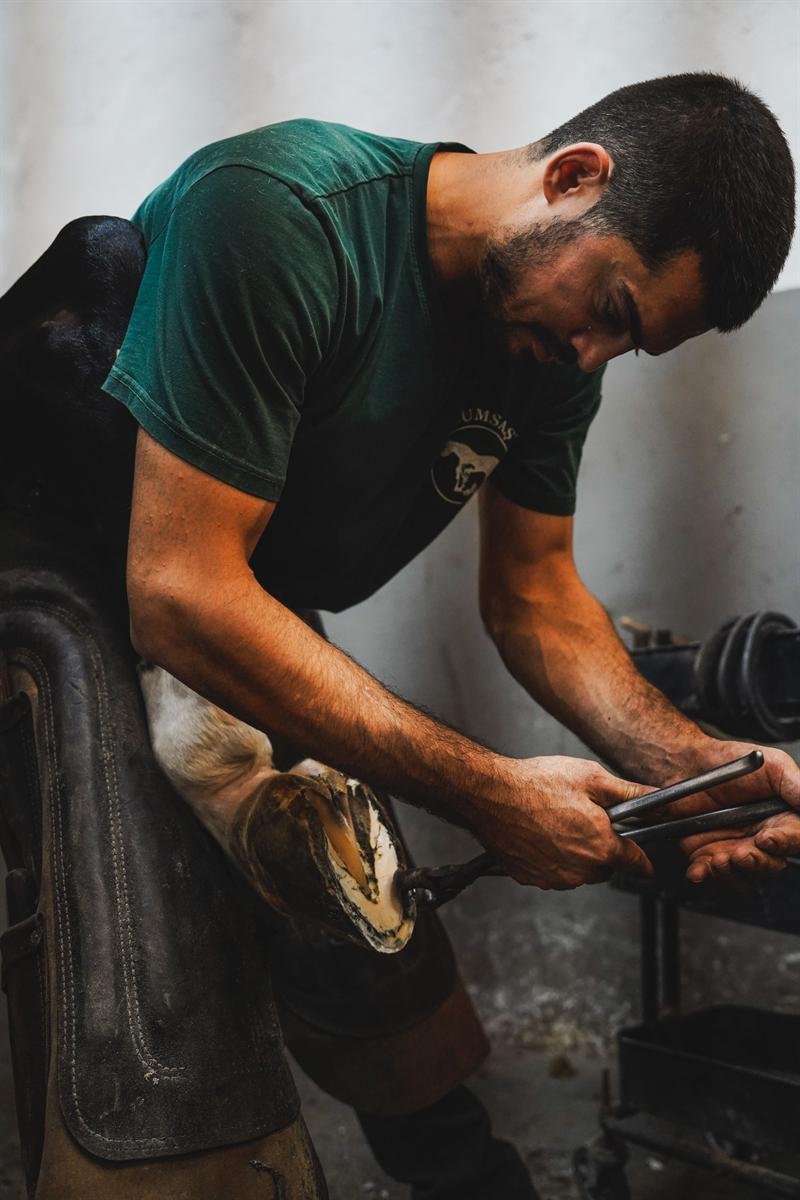
To find a farrier in the UK, start with the Farriers Registration Council (FRC) register, because only registered farriers may legally shoe horses. After that, look for reliability, good communication and someone your horse stands quietly for.
Find farriers by region
More regions are being added. Run a business that should be here? List it for free.
What a farrier does
A farrier looks after your horse’s feet: trimming the hoof, balancing it, and where needed making, fitting and nailing on shoes. A good farrier also watches how your horse moves, spots changes in the foot early and works with your vet when there is lameness, laminitis or an injury. Because the foot is the foundation of soundness, the quality of farriery affects comfort, performance and long-term health. Our guide to hoof care explains what a healthy foot looks like between visits.
Most farriers are self-employed and work from a van fitted with a portable forge or gas equipment. They travel to yards and private homes, so many owners find a farrier by recommendation from neighbours, their yard or their vet, then check the register before booking.
Registration and qualifications to check
Under the Farriers (Registration) Act 1975, it is an offence for anyone who is not registered to carry out farriery, which includes shoeing, for gain. The FRC keeps a public register that you can search online by name or area, so checking takes only a minute. Registered farriers have completed an approved apprenticeship and passed the relevant examinations, usually the Diploma of the Worshipful Company of Farriers (DipWCF). You may also see further letters such as AWCF (Associate) or FWCF (Fellow), which indicate additional advanced examinations.
Apprentices can legally shoe only as part of their training under an approved training farrier. If someone who is not on the register offers to shoe your horse, that is a clear red flag, regardless of how experienced they say they are.
Trimming alone is not covered by the same restriction, which is why unregistered barefoot trimmers can work legally. If you use one, check their training and insurance, and keep your vet informed if your horse has any foot problem. For conditions such as laminitis, white line disease or poor hoof balance, a registered farrier working alongside your vet is the safest route.
How to find a farrier near you
- Ask locally: your yard owner, vet, instructors and neighbours will know who is reliable and who has space for new clients.
- Search the FRC register: look up farriers by area and confirm the name you were given is listed.
- Contact two or three: ask if they are taking new clients and how far they are willing to travel.
- Book a trial visit: one appointment tells you a lot about timekeeping, handling and how well they explain their work.
- Watch and ask: a good farrier is happy to explain what they are doing and why.
Be prepared for waiting lists. Good farriers are often booked weeks ahead, and in some rural areas new clients can take time to be accepted. Starting your search before you need someone is far easier than looking in a hurry when a shoe has come off.
What makes a good farrier for you
- Regular, reliable visits: they turn up when agreed, or tell you in good time if they will be late.
- Handling: calm and patient with youngsters, nervous horses and anxious owners alike.
- Willingness to work with your vet: especially for lameness, corrective work or X-ray guided shoeing.
- Clear communication: explains what they see in the feet and why they recommend changes, rather than simply doing the same thing every time.
- Safe working: a tidy, properly equipped van and a sensible approach to working around horses and people.
- Suited to your horse’s job: a competition horse, a heavy breed, a retired veteran and a youngster all have different needs.
Questions to ask before booking
- Are you on the FRC register, and what is your registration level?
- Are you taking on new clients in my area, and how often can you visit?
- What do you charge for a trim, front shoes and a full set, and is there a call-out fee?
- Do you have experience with my type of horse, such as a heavy breed, a youngster or a competition horse?
- How do you handle cancellations, emergency lost shoes and last-minute appointments?
- Are you happy to speak to my vet if my horse has a foot problem?
- Will you tell me if you think my horse could manage without shoes, or needs different shoes?
Red flags
- Not on the FRC register but offering to shoe for payment.
- Reluctance to explain what they are doing or to talk to your vet.
- Rough handling, losing patience quickly or leaving a horse distressed.
- Nailing on shoes without properly balancing and preparing the foot.
- Repeatedly cancelling or arriving without warning, leaving your horse overdue.
- Pressure to buy unnecessary extras or very different advice each visit with no explanation.
How often will you need a farrier?
Most horses need attention every four to eight weeks, depending on how fast the hoof grows, the workload, the surface they work on and whether they wear shoes. Horses in regular hard work, with poor horn quality or with a corrective plan may need visits closer to four weeks, while some barefoot horses on easy workloads can go a little longer. Your farrier will advise on a schedule for your horse. Do not leave long gaps in the hope of saving money, because overgrown feet, stretched shoes and uneven wear can lead to lameness that costs far more to put right.
Typical costs in 2026
| Service | Rough cost in 2026 |
|---|---|
| Trim | roughly £35–£60 |
| Front shoes | roughly £60–£100 |
| Full set of shoes | roughly £90–£150 |
| Remedial or specialist shoes | higher, by quote |
| Emergency or out-of-hours visit | higher, plus any call-out fee |
Prices vary by region, travel distance and the individual farrier, and rise for heavy horses or specialist work. A cheap price is not automatically poor value, but unusually low fees combined with no registration are a warning sign. Budgeting for an annual farriery cost is part of the bigger picture in our cost of owning a horse guide.
Farrier checklist
- Checked their name on the FRC register.
- Confirmed availability, call-out area and price for trim, front and full sets.
- Asked about experience with your type of horse.
- Agreed a regular interval and how to contact them in an emergency.
- Made sure your yard has a safe, dry, level area for the visit.
- Saved your vet’s number in case the farrier finds something concerning.
FAQs
How do I check a farrier is registered?
Search the Farriers Registration Council’s public register by name or area. Only registered farriers can legally shoe horses for payment.
Can a barefoot trimmer replace a farrier?
Trimmers are not regulated in the same way and cannot legally shoe. Check their training and insurance, and tell your vet if your horse has a foot problem.
How long should a visit take?
A trim may take 20 to 30 minutes and a set of shoes 45 to 90 minutes, depending on the horse and the work needed.
What should I do if a shoe comes off?
Keep the horse on a soft surface, avoid work and call your farrier. Contact your vet if there is lameness, bleeding or damage to the foot.
How much does a farrier cost?
Roughly £35–£60 for a trim and £90–£150 for a full set of shoes in 2026, varying by region and horse.
Does my horse need shoes at all?
Not always. It depends on the work, the ground and the quality of the foot. Ask your farrier and vet for an honest opinion.
Get your business listed
We're building the UK's most useful directory of farriers. Run a farriery business? List your business for free.
Useful official resources
- RCVS Find a Vet Find a registered equine vet.
- Society of Master Saddlers Find a qualified saddle fitter.
- BAEDT Find a qualified equine dental technician.