
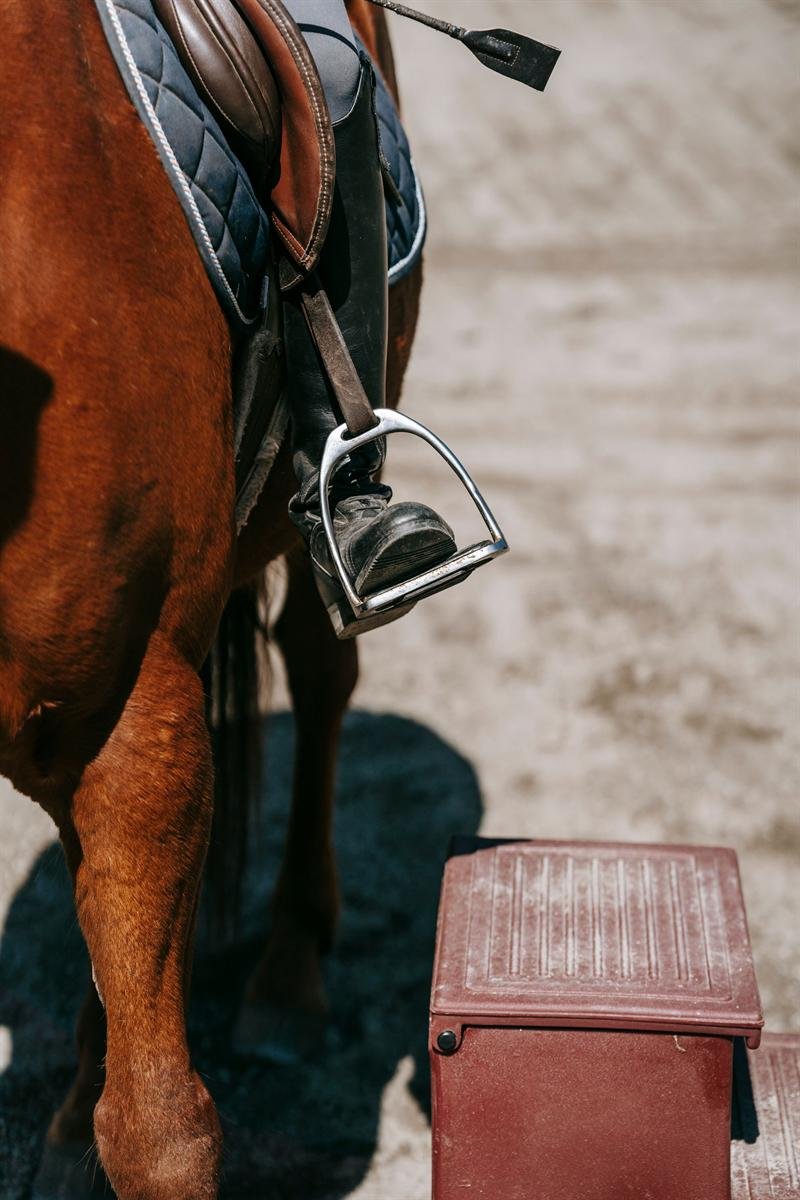
Stirrups and stirrup leathers connect your feet to the saddle, so they affect your balance, your safety and your horse's comfort. The right stirrup irons are about an inch wider than the widest part of your boot, the leathers must be sound and the correct length, and safety stirrups are worth considering for anyone, and especially for children.
What stirrup irons and leathers do
Stirrup irons support your feet and help you keep your lower leg stable and your weight balanced. The leathers attach them to the saddle bars and let you adjust the length to suit your height, your discipline and your position. Together they are safety-critical equipment: if either fails, you can lose balance, and if a foot becomes trapped, you can be dragged in a fall.
Because they work with the saddle, they are part of your overall position. If you are new to riding, our riding position guide explains why a stable lower leg matters.
Types of stirrup irons
- Traditional stainless steel irons: strong and long-lasting. These are the usual choice for everyday riding, but they have a narrow opening that can trap a foot in a fall if the size is wrong.
- Safety stirrups: designed to release the foot more easily in a fall. Some have a quick-release outside branch or a flexible side, and others have a sloping or angled shape. They are popular for children and nervous riders.
- Lightweight and composite irons: made from lighter metals or tough synthetics, often with a wide base and cushioning for comfort over long rides.
- Endurance and trail stirrups: wide, cushioned and designed to ease pressure on the feet and legs over long distances.
- Jumping and eventing irons: usually with a wider footbed and good grip to keep the foot secure when riding over fences.
The best safety design for you depends on your riding and your equipment, so ask a qualified saddle fitter or your instructor, and choose products from reputable suppliers.
How to size stirrup irons
If you wonder how to size stirrup irons, the rule of thumb is simple. The iron should be wide enough that your boot fits without being squeezed, but not so wide that your foot can slip through.
- Wear the boots you normally ride in, as boot width varies from slim dress boots to chunky winter yard boots.
- Check that there is roughly a finger's width, around half an inch, of space on each side of the widest part of the boot.
- Avoid irons that are much too wide, as the whole foot may slide through the opening in a fall.
- Avoid irons that are too narrow, as the boot can jam and trap your foot.
- Re-check the size when the weather turns and you change to thicker boots, or when a child's feet grow.
| Check | What you want | Why it matters |
|---|---|---|
| Width | A little room each side of the boot | Allows the foot to release easily |
| Height of the opening | Tall enough for the boot, not much taller | Prevents the foot sliding through |
| Footbed | Flat, grippy or treaded | Keeps the foot stable |
| Weight | Heavy enough to hang correctly | Helps the iron stay in place when you mount |
Stirrup treads and grip
Stirrup treads are rubber pads that sit in the base of the iron. They give grip, reduce vibration and help the foot stay securely in place, particularly in wet weather when boots can slip. Some are fitted by sliding them into the base, while others are built into the iron.
- Check that treads are the right size for your irons, and fit them securely.
- Replace treads when they wear smooth.
- Make sure the treads do not make the iron too tight for your boot.
Choosing stirrup leathers and the right length
Stirrup leathers are normally made from leather, though there are also synthetic and webbing versions that some riders prefer for strength and low maintenance. They come in different lengths and widths, and the correct size matters for both comfort and safety.
To find your stirrup leather length, a common starting point is to measure the leather against your arm with the iron on: hold the iron against your armpit and stretch the leather along your arm to your fingertips. For many riders, this puts the iron at a sensible length for flatwork, though you will adjust it for your own legs, discipline and riding position. Jumping stirrups are shorter than dressage ones.
- Choose leathers that are long enough for your tallest setting with some spare holes.
- Look for a pair matched in length, and replace both together.
- Stretch can make leathers uneven. Swap the left and right leathers from time to time to even out the wear.
Checking stirrups and leathers for wear
Because stirrup leathers carry your full weight, they must be checked regularly. Inspect them every time you tack up and give them a closer look every month.
- Look for cracks, splits and thin patches, particularly around the buckle holes and where the leather bends over the iron.
- Check the stitching on the buckle area and the keepers.
- Make sure the holes have not stretched into slots.
- Examine the iron for bends, cracks or sharp edges, and check that the treads are in place.
- Check that the stirrup bar on the saddle is open (where applicable) so the leather can fall away in an emergency.
If a leather looks worn, replace it. A broken leather can cause a fall. For routine cleaning, see our tack care and leather care guides.
Safety stirrups and children
Children's feet can get stuck in standard irons, so safety stirrups, good fitting boots with a small heel and an approved riding hat are all important. Supervising adults should check the stirrup size, leather condition and tack fit before each ride. Riding schools approved by the British Horse Society or Pony Club centres will usually have suitable equipment and check it regularly. See our young riders safety guide for more.
What to look for when buying stirrups and leathers
- Right size: measure against your riding boots and leave a little space each side.
- Safety features: consider a design that releases the foot, especially for children or less confident riders.
- Material and strength: choose reputable, well-made products, and avoid decorative items that are not designed to take your weight.
- Grip: check that the footbed is non-slip and the treads are fitted well.
- Leather quality: look for even, firm leather and clean stitching.
- Compatibility: make sure your saddle's stirrup bars suit your leathers and irons.
- Budget: a sensible pair of irons and leathers can cost anywhere from a modest sum to a substantial one, depending on materials, and prices vary. Do not compromise on safety to save money.
Frequently asked questions
What size stirrups do I need?
Choose irons about half an inch wider than the widest part of your riding boot on each side, so your foot fits freely but cannot slip through. Check with the boots you normally wear.
Are safety stirrups worth buying?
Many riders find them worthwhile, particularly for children, as they are designed to release the foot more easily in a fall. They do not remove all risk, so correct boots and a hat remain essential.
How long should my stirrup leathers be?
A common starting guide is the length from your fingertips to your armpit, with the iron attached. You then adjust for your discipline and legs, so a jumping length is shorter than a dressage length.
How often should I replace stirrup leathers?
There is no fixed time. Replace them when you see cracks, stretching or worn stitching, and consider replacing them sooner if they have had heavy use.
Do I need stirrup treads?
They are not compulsory, but they help the foot grip and reduce slipping. Make sure they are replaced when worn.
Why do my stirrups feel uneven?
Leathers stretch unevenly with use, and the saddle or rider may also be crooked. Swap the leathers side to side regularly and ask an instructor or saddle fitter to check your position and saddle.
Useful official resources
- Society of Master Saddlers Find qualified saddle and bridle fitters.
- BETA The British Equestrian Trade Association.