
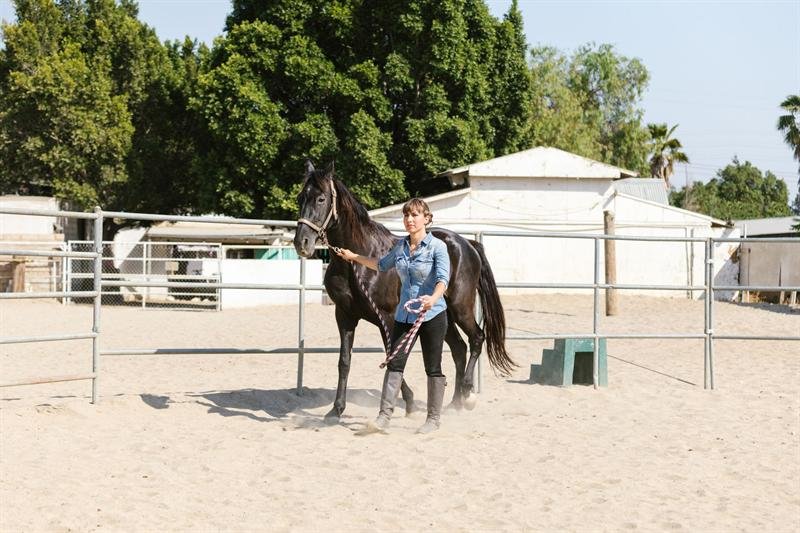
Horse groundwork is training done on the ground, before or alongside riding, to teach your horse to respond to light cues, respect your space and trust your leadership. Ten calm minutes a day on leading, halting and yielding will make everything from tacking up to loading easier and safer.
What is groundwork and why does it matter?
Groundwork teaches the language of pressure and release without the complication of a rider's weight. The horse learns that a light cue means something, that he can find the answer, and that the pressure disappears the moment he does. That simple pattern underpins almost everything else you will ever ask of him.
It also tells you a great deal about your horse. On the ground you can see who is worried, who barges, who switches off and who is simply confused. Because you are standing next to him rather than sitting on him, you can step out of the way if something goes wrong. Good groundwork is the foundation of lunging, long-reining and backing, and it is just as valuable for an older horse as for a youngster.
Groundwork for beginners: what you need
You do not need specialist gear. A well-fitting headcollar or a training halter with a soft knot, and a lead rope of about three metres, are plenty to begin with. Some trainers add a longer line or a schooling whip used as a visual extension of the arm, never as a weapon.
- Wear a hat, gloves and sturdy boots.
- Choose an enclosed, level area with good footing and no distractions to begin with.
- Never wrap a rope around your hand or fingers.
- Check the headcollar fits snugly without rubbing and that the knots are secure.
- Work when you are calm and have time; rushing is the quickest way to lose a horse's trust.
The principle: pressure and release
Horses are natural pressure-followers. A horse that leans into a rope has not been rude; he has simply not yet learned that giving to the pressure makes it stop. Every exercise below uses the same three steps.
- Ask lightly: begin with the lightest cue that could possibly work, such as a change in your body posture or a small movement of the rope.
- Increase gradually: if there is no response, add a little more, a touch, then a firmer touch, never jumping straight to something harsh.
- Release instantly: the moment the horse offers the right answer, even a tiny shift of weight, take the pressure away and, if you wish, praise him with your voice or a scratch on the withers.
The release is the lesson. Horses repeat what is rewarded, so the timing of your release matters more than the strength of your ask.
Horse leading exercises
Good leading means the horse walks beside your shoulder, matches your pace and halts when you halt, with a loose rope between you.
- Position: walk beside the horse's shoulder, not in front of him and not dragging behind. Keep your own pace steady and look where you are going.
- Halt: stop your own feet and breathe out. Most horses will halt with you. If he keeps walking, apply gentle pressure on the rope and release the moment he stops.
- Walk on: take a step with a clear intention and let the rope go slack. If he does not follow, ask with a small forward movement of the rope hand or a tap of a finger on the shoulder.
- Turns: practise turning away from the horse so he learns to step back and out of your way, then turning towards him as you become more confident.
- Straight lines and corners: walk a square or an L-shape, halting and walking on again at each corner.
Practise in the arena first, then in the yard and in hand to the field. Horses that lead well in a quiet space may need to relearn manners when excited, which is why consistency matters.
Teaching a horse to yield
Yielding means moving a part of the body away from light pressure. It teaches the horse to respond willingly and gives you a calm way to move him out of your space without any force.
| Exercise | How to ask | What you are looking for |
|---|---|---|
| Yield the hindquarters | Stand near his side, face his hip, and apply gentle pressure or point at the hip | Inside hind leg steps across and in front of the other; he stays relaxed |
| Yield the forequarters | Stand near the shoulder and ask the front end to step away | Front legs cross, with the horse turning around his hindquarters |
| Back up | Wiggle the rope gently or apply light fingertip pressure on the chest | A clean step or two backwards, head low and straight |
| Lower the head | Light downward pressure on the headcollar | The head drops and he softens; this is also a calming exercise |
| Stand still | Ask him to wait while you move around him | He stays put without fidgeting; build duration slowly |
Reward the smallest try, even a shift of weight in the right direction. Over days and weeks, ask for a little more, one step instead of a lean, two steps instead of one.
Personal space, respect and manners
Many owners search for groundwork to build respect. The idea is straightforward: a horse should not barge into you, walk over you or crowd you at gates and doors. Teach him that the space around you is yours, and he may enter it only when invited.
- If he crowds you, ask him calmly to step back, and be consistent every time, not just when you are in a hurry.
- Insist on manners at feeding time, at the gate and when being led in and out of the stable.
- Avoid hitting or shouting; they usually create fear or defensiveness rather than genuine respect.
- Reward the polite behaviour you want, so he finds standing quietly rewarding in itself.
If nipping or kicking is part of the picture, see biting and kicking, and work with an experienced person. Behaviour that is suddenly out of character is also a reason to check for pain; see the section on when to call your vet below.
A simple ten-minute routine
- Walk him out and halt several times, checking he waits for your cue.
- Ask for a few steps back, then walk on again.
- Yield the hindquarters both ways, and the forequarters both ways.
- Ask him to stand while you walk a circle around him.
- Finish with a gentle scratch and a walk on a loose rope.
Short and often is better than long and rare. Even a few minutes while the kettle boils builds habits that stay with him under saddle.
Common groundwork mistakes
- Nagging: constant tugging teaches the horse to ignore you. Ask, wait and release.
- Late release: holding the pressure after he has tried teaches him that trying does not help.
- Inconsistency: allowing barging one day and punishing it the next confuses the horse.
- Working in a bad mood: horses read body language very well. If you are tense, he will be too.
- Skipping the basics: advanced exercises collapse without solid leading and halting.
Safety first
- Stand beside the shoulder, not directly in front of or behind him.
- Always wear a hat and gloves when working a young or excitable horse.
- Keep your feet clear of his, and stay aware of his hind legs.
- If a session is going badly, stop, take a breath, and return to something easy.
- If a horse is dangerous, with rearing, striking or genuine aggression, stop and ask for help from a qualified, experienced trainer or behaviourist rather than escalating.
Persistent trouble despite good groundwork often has an underlying cause. Pain from teeth, back, feet or tack is a common reason a horse seems disobedient; see problem horses for a structured approach.
FAQs
Is groundwork only for young or problem horses?
No. Every horse benefits, and it is a good way to refresh the basics with a rescue, a returning horse or an older horse as well as with youngsters.
How long should a groundwork session last?
Ten to twenty minutes is normally enough, and short sessions more often are better than long ones. Stop on a success.
Do I need special equipment?
No. A well-fitting headcollar and lead rope are enough to begin. Some trainers use rope halters or a longer line for more advanced work, but good timing matters more than equipment.
How do I teach my horse respect on the ground?
Be clear and consistent about personal space, ask for polite behaviour calmly, and release pressure the instant he responds. Force and shouting tend to create fear rather than respect.
Can I do groundwork if I am a beginner?
Yes, with a quiet, well-mannered horse and an experienced person nearby. A qualified instructor can check your timing and body language, which is where most beginners need help.
When should I ask a professional for help?
If your horse rears, strikes, kicks or shows aggression, or if you feel unsafe, stop and ask your vet to rule out pain, then seek a qualified trainer or behaviourist.
Useful official resources
- The British Horse Society Training, coaching and qualifications.
- World Horse Welfare: advice Handling and welfare guidance.