
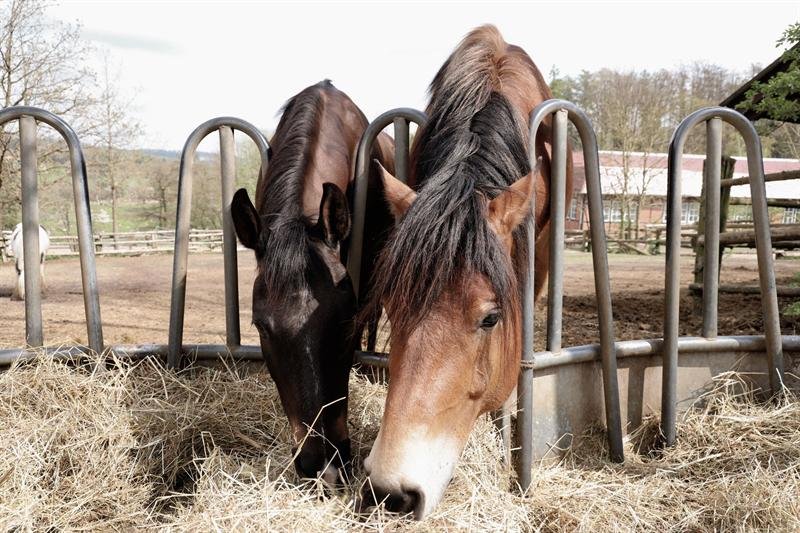
Haylage for horses is grass that has been cut, partly dried to a higher moisture content than hay, and then baled and wrapped airtight so it ferments lightly and keeps. It is not automatically better or worse than hay: the right choice depends on your horse's health, workload, dust sensitivity and weight, and on the quality of the particular bale.
What is haylage?
Hay is dried in the field until it is stable, usually to around 85% dry matter or more, and is stored without being sealed. Haylage is cut at a similar time but baled while still damp, often at roughly 50–70% dry matter, then wrapped tightly in plastic. With little oxygen, a mild fermentation happens that preserves the grass. Because it is not fully dried, it is more palatable to many horses, has less dust, and typically provides more nutrients per kilo as fed. However, it also contains more water, so a kilo of haylage supplies less dry matter than a kilo of hay. This matters when you weigh out rations.
Haylage vs hay
| Feature | Hay | Haylage |
|---|---|---|
| Moisture | Low | Higher |
| Dust and spores | Can be dusty unless soaked or steamed | Very low dust when properly made |
| Palatability | Good, varies with quality | Often more attractive to horses |
| Calories per kilo as fed | Typically lower | Often higher, but varies with the crop |
| Storage | Dry, ventilated, off the ground | Sealed; spoils once the wrap is damaged or opened |
| Once opened | Keeps well | Needs using within days |
| Cost | Often lower per bale | Often higher per kilo of dry matter |
See our hay guide for more on hay itself.
Is haylage better than hay?
Not necessarily. Haylage can be a good option for horses with respiratory sensitivity, as it is typically lower in dust, and for horses that need a bit more energy from forage, such as fit competition horses or poor-doers. Many horses find it tastier. But some haylage is quite rich, and for good doers, ponies and horses prone to laminitis or insulin dysregulation, it can be too high in sugar and calories. Hay, especially mature meadow hay that is soaked where advised by a vet, may suit these horses better. Both can be dusty, mouldy, or poorly made, so inspection matters more than the label.
How much haylage to feed
The widely accepted rule is that total forage should be roughly 1.5–2.5% of bodyweight in dry matter per day. Because haylage contains water, you need to feed more by weight than hay to supply the same dry matter. As a rough illustration only, a 500kg horse on about 2% of bodyweight needs around 10kg of dry matter a day. If the haylage is around 60% dry matter, that is roughly 16–17kg as fed, whereas hay at around 85% dry matter would be roughly 12kg. Check the dry matter on the bale label or analysis. Then:
- Estimate bodyweight with a weigh tape or weighbridge.
- Check the haylage's dry matter percentage if known; if not, ask the supplier.
- Work out the daily dry matter target and convert to kilos as fed.
- Weigh a typical net or armful so you know what you are feeding.
- Monitor weight and body condition, and adjust over a few weeks.
Most manufacturers offer small bales, and some give guidance on bale weight and how many horses a bale feeds. A horse in a field or on restricted rations will need different amounts, so see feeding charts for planning.
Haylage for good doers
Many ponies and good doers put on weight easily, and a rich, young haylage can quickly provide too many calories. If you want to feed haylage to an easy keeper, ask your supplier for a lower-energy, mature, later-cut type, and request an analysis showing sugar (water-soluble carbohydrate) and energy values, often called digestible energy. Even then, restricted rations must not fall too low, as feeding less than about 1.5% of bodyweight in dry matter is generally not advised without veterinary guidance. Slow-feed nets with small holes make a ration last longer and mimic natural grazing. Our weight loss guide goes into more detail, and hay nets explains the options.
Introducing haylage safely
As with any dietary change, move gradually over roughly seven to ten days, replacing part of the old forage each day, so the gut bacteria can adjust. Some horses become looser in the droppings or more excitable on rich haylage. Watch for these signs and slow down or choose a different type. Never switch abruptly, and do not leave horses without forage while you work out the change.
Storage and safety
- Check the wrap. Holes, tears or punctures let air in and cause mould. Mouldy haylage should not be fed.
- Store off the ground on a pallet or hard standing, away from vermin, and protected from sharp objects and direct sun where possible.
- Use quickly once opened. Most guidance suggests using a bale within a few days, especially in warm weather, because it spoils faster than hay.
- Inspect every bale. Look for visible mould, a bad smell, slimy or heated forage, and discard any suspect forage.
- Beware botulism. Spoiled haylage, or forage contaminated with animal carcasses, has been linked to botulism, a serious and often fatal condition. Discard dubious bales and talk to your vet about vaccination where relevant.
- Wear gloves and cut wrap away safely and dispose of the plastic properly, away from horses.
What to look for when buying haylage
- A clear description of the grass type, cut date and the dry matter percentage.
- An analysis of energy and sugar, especially for ponies, good doers and metabolic horses.
- Undamaged wrap, tight bales, and no signs of mould, smell of ammonia or heating.
- Bale sizes that match your horse numbers so you finish each one within a few days.
- Reliable supplier with consistent quality, storage space and delivery arrangements.
- A price compared per kilo of dry matter, not just per bale.
FAQs
Is haylage better than hay?
Not always. Haylage is lower in dust and often more palatable, but can be richer, so hay may suit good doers and metabolic horses better.
How much haylage should I feed a horse?
Aim for roughly 1.5–2.5% of bodyweight in dry matter per day for total forage. Because haylage contains water, you feed more by weight than hay.
Can I feed haylage to a pony that gets fat?
Possibly, if you choose a low-energy, low-sugar haylage and restrict the ration sensibly. Ask for an analysis, and check with your vet if the pony has had laminitis.
How long does haylage last once opened?
Usually only a few days, and less in warm weather. Use small bales, and discard anything mouldy.
Is haylage good for horses with a cough?
It is often chosen because of its low dust content, but your vet should advise on respiratory problems. See our guide to respiratory problems.
Can haylage cause colic?
Any sudden diet change or spoiled forage can contribute to digestive upset, so introduce it gradually and check every bale.
Useful official resources
- World Horse Welfare: advice Body condition scoring and feeding guidance.
- British Equine Veterinary Association The professional body for equine vets.
- Code of Practice for the Welfare of Horses (gov.uk) Legal standards for feeding and care.