
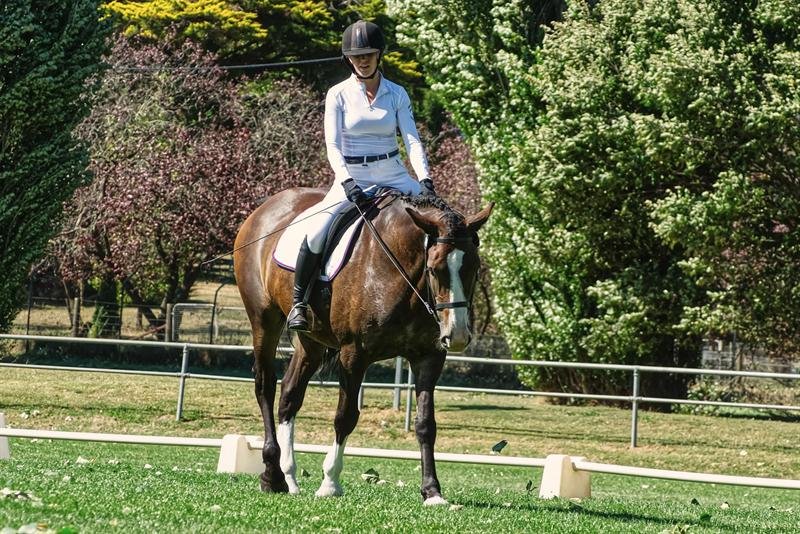
Dressage for beginners starts with one idea: it is the systematic training of a horse to be supple, obedient and balanced, shown through a set test of movements in an arena. You do not need an expensive horse or a fancy outfit to begin, because affordable local tests at introductory level are a friendly way to learn what dressage is and how to start.
What is dressage?
The word comes from the French for "training", and that is exactly what it is. At its heart, dressage is the flatwork that underpins every other riding discipline, from show jumping to eventing, arranged into a performance. A good test looks effortless: the horse moves forward willingly in a steady rhythm, accepts the rider's aids without fuss and stays balanced through every turn and transition.
For most riders, the appeal is that you are always competing mainly against yourself. A test can be ridden on a cob, a native pony, a Thoroughbred type or a warmblood, and a rider on a modest horse who rides accurately and kindly will often score well. Many people enjoy dressage purely as a way to improve their riding and their horse's way of going, without ever entering a competition.
The training scale
Judges and trainers talk about the training scale, a sequence of qualities that build on one another. Understanding it helps you see why a test is marked the way it is.
- Rhythm: a regular, even beat in each pace, with a consistent tempo.
- Suppleness: a relaxed horse who swings through his back and bends easily in both directions.
- Contact: a soft, steady, elastic connection from the rider's hand to the horse's mouth, with the horse going forward into it.
- Impulsion: controlled energy from the hindquarters, not simply speed.
- Straightness: the horse's hind feet following the line of his front feet, on straight lines and on curves.
- Collection: carrying more weight behind, which develops gradually over years rather than weeks.
Beginners should focus on the first three. Rushing for a "frame" by pulling the head in is the quickest way to lose marks, as it breaks the order of the scale and usually creates tension.
What judges look for
Each movement in a test is marked from 0 to 10, and the judge usually writes a short comment on the sheet. At the end there are collective marks, which cover areas such as paces, impulsion, submission and rider position and effectiveness. Your final score is normally given as a percentage, so you can compare results across different tests and judges.
Judges reward a calm, forward-going horse that is relaxed and accurate. A flashy horse that is tense, or that rushes through transitions, often scores lower than a quieter partner who does everything correctly. Accuracy matters a great deal: a circle that is the right size, a transition made at the letter and a straight centre line are easy marks to win. Learn the arena letters until you can picture them without thinking. Our guide to schooling for riders covers practical exercises, and judging explains more about how marks are awarded.
British Dressage levels
British Dressage (BD) is the national governing body, and its tests are arranged in levels of increasing difficulty. The names below are the broad ladder, though the exact tests at each level change from time to time.
| Level | What it involves |
|---|---|
| Introductory and Preliminary | Walk, trot and, at Preliminary, simple canter; ideal first tests |
| Novice | More balance and suppleness; simple lateral work and changes of canter lead through trot |
| Elementary | Greater engagement; lengthened strides, 10m circles, counter canter in some tests |
| Medium and Advanced Medium | Early collection; shoulder-in, travers and flying changes begin to feature |
| Advanced and above | Higher-level collection, half-pass, pirouettes; Prix St Georges, Intermediate and Grand Prix |
Always check the current tests on the British Dressage website before you learn one, because test content and names are updated periodically. Tests can be ridden in a smaller arena (20m x 40m) or a full-size arena (20m x 60m), and the venue will tell you which it uses. See British Dressage for membership and rules, and riding clubs for a more relaxed route in.
How to start dressage: step by step
- Get the basics in place: a steady walk, trot and canter, accurate circles and smooth transitions. A few lessons from a good instructor will save months of guesswork; see riding lessons.
- Choose a first test: pick one level below what you can do easily at home. A confident, accurate test beats a stretched one.
- Learn the test: many riders memorise it by breaking it into chunks and walking the pattern on foot. Some classes allow a caller, so check the rules for the class you enter.
- Practise the figures, not just the test: circles, transitions at the right letter and straight centre lines. Riding the whole test over and over at home teaches your horse to anticipate.
- Enter a friendly competition: riding club shows, unaffiliated events and local venues are cheaper and welcoming. Move to affiliated classes when you are ready.
- Prepare tack and turnout: check the rules on permitted bits, saddlery, dress and whips. See competition rules.
- Review your sheet afterwards: the judge's comments tell you what to practise next.
Dressage tack and turnout
Dressage uses a dressage saddle with a longer, straighter flap and a deeper seat, though a well-fitting general-purpose saddle is acceptable at lower levels. Bits and nosebands are limited by the rules, so check the current list before competition. Riders typically wear a plain jacket, white or pale breeches, a stock or tie, gloves and long boots, with the hat covered in a dark colour. At unaffiliated and riding club level, dress rules are often more relaxed.
Whatever you wear, your hat is not negotiable. Choose one that meets a current standard, such as PAS 015 or VG1 01.040, ideally carrying an independent certification mark, and replace it after any significant fall or knock. Fit matters as much as the label, so have it fitted by someone trained to do it, and keep the harness correctly adjusted. Our riding safety guide has more on this.
Test day and nerves
Allow plenty of time to arrive, walk the horse around, check the arena and warm up quietly. The warm-up is for relaxing the horse and checking that the aids work, not for teaching new things. Many riders find it helps to ride the corners and transitions they know are strong, and to finish on a good note rather than over-schooling.
Nerves are normal. Breathe out, ride the next movement and not the last one, and remember that the judge wants you to do well. If you go wrong, carry on calmly, because every rider does it at some point and the penalty is small compared with a tense, stop-start test.
Is my horse ready?
Dressage is physically demanding, so your horse needs to be sound, comfortable in his back and mouth and fit enough to work in a rhythm for the length of a test. Teeth, saddle fit and feet all affect how a horse moves, so ask your vet, dentist and saddle fitter to check them if schooling suddenly becomes difficult. If your horse seems stiff or uneven, see lameness before you ask for more work. Young horses should be introduced gently; see young horses.
FAQs
Do I need a warmblood to do dressage?
No. Any sound, well-schooled horse or pony can do dressage, and many riders compete successfully on cobs, native breeds and Thoroughbred types, particularly at lower levels.
What is the easiest dressage test for a beginner?
Introductory tests, which are walk and trot only, are the usual starting point. Choose a test that your horse can do calmly, and enter one level below your schooling at home.
Can I do dressage if I hack more than I school?
Yes. Hacking helps fitness and relaxation, and a bit of flatwork each week will make a big difference to your test performance. See hacking for ideas on varying your rides.
How is a dressage test scored?
Each movement is marked out of 10, collective marks are added and the total is converted to a percentage. Penalties apply for errors of course.
What happens if I go wrong in a test?
The judge will ring a bell and usually tell you where to resume. You will lose marks for the error but can carry on, and repeated errors can lead to elimination, so keep calm and ask if you are unsure.
Do I have to join British Dressage to compete?
Not at first. Unaffiliated and riding club competitions do not need BD membership. You need to join if you want to enter affiliated classes.
Useful official resources
- The Highway Code: rules for horse riders (gov.uk) Rules 47 to 58 for riding and leading horses on the road.
- The British Horse Society Riding, safety and access advice.
- British Riding Clubs Training and competition for adult riders.