
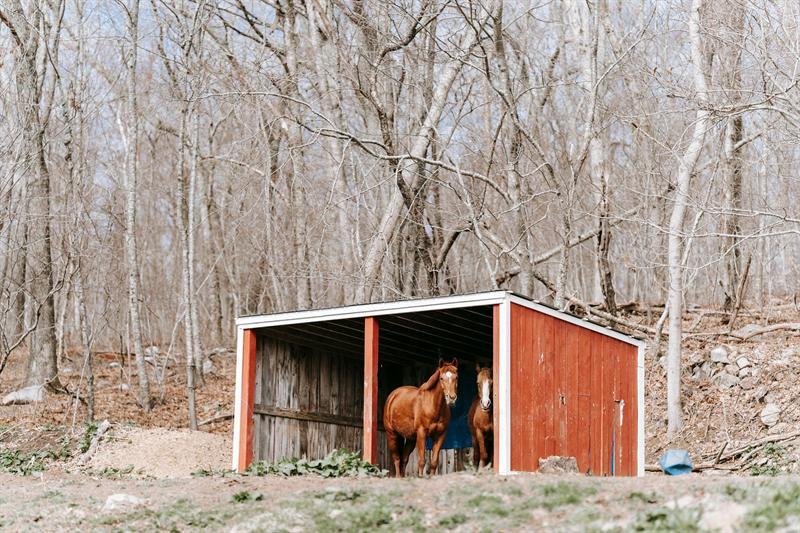
Horse field shelters give horses somewhere to escape wind, driving rain, summer sun and flies without being shut in. A typical field shelter is around 12ft x 12ft (3.6m x 3.6m) per horse, open-fronted and facing away from the prevailing wind, which in most of the UK means open to the east or south-east. Whether you can put one up without planning permission depends on your site, so always check first.
Why horses need a field shelter
Horses that live out are generally hardy, but they still benefit from a place to get out of the worst weather. In winter a shelter breaks the wind and keeps rain off the back and rump. In summer it gives shade and a refuge from flies, which many horses use more than owners expect. A shelter can also be a handy place to feed hay out of the wet, to hold a horse briefly for the vet or farrier, or to provide a dry spot in a muddy field.
Shelter is part of good all-year care. Natural shelter such as a thick hedge or a stand of trees can help, but it is rarely as reliable as a purpose-built shelter, and trees bring their own risks. See winter care and summer care for how shelter fits into the seasons.
Field shelter sizes
Allow roughly 12ft x 12ft per horse, or 12ft x 10ft per pony, with extra space for each additional animal. Horses in a group need enough room that a lower-ranking horse cannot be trapped in a corner by a dominant one. A shelter for several horses should be long and open-fronted, with a wide front or two ways in and out, rather than a small, deep box. Bigger horses need more room, and when in doubt, go larger.
| Horses | Rough guide to floor area | Notes |
|---|---|---|
| One pony | Around 12ft x 10ft (3.6m x 3m) | Allow extra room for a pony with a foal |
| One horse | Around 12ft x 12ft (3.6m x 3.6m) or larger | Larger breeds need more space |
| Two horses | Around 24ft x 12ft (7.3m x 3.6m) | Long and open-fronted, not a small box |
| Three or more | Add roughly one horse-space each, and consider two shelters | Dominant horses may guard a single shelter |
These are guides, not rules. Roof height needs to be tall enough for a horse to raise its head fully, usually around 2.4–3m at the eaves. Floors can be compacted hardcore, concrete or rubber mats laid over a hard base.
Where to site a field shelter
- Face the open front away from the prevailing south-westerly winds and driving rain.
- Choose well-drained, slightly raised ground, because shelters on low spots end up surrounded by mud.
- Avoid corners where a horse can get trapped, and keep clear of fence lines so horses cannot be cornered or use the roof to get out.
- Think about access for clearing droppings, hay delivery, the vet and the farrier.
- Do not place under trees that might drop limbs, or near overhead power lines.
- Leave enough room around each side so horses can circulate rather than stand blocked in.
Consider the whole field. A shelter in a gateway area will attract poaching; a hard-standing apron in front helps keep the entrance usable in winter. Your fencing and pasture rotation plan should be considered together with the shelter location, so each paddock in a rotation has access to cover where possible.
Mobile field shelters vs fixed
A mobile field shelter is built on skids or a strong base so that it can be moved with a tractor or similar. This suits rotated paddocks, rented land and anyone who may move yard. Fixed shelters sit on a prepared base and are more permanent. Mobile shelters still need weighting or anchoring in exposed sites, and moving one should be done with care to avoid damage to the structure and to the ground.
Planning permission for a field shelter
Rules on field shelters are not simple. Whether you need planning permission can depend on the size of the building, whether it is fixed or movable, how the land is classified and used, and whether the site is in a conservation area, green belt, national park or similar protected setting. A movable shelter may be treated differently from a permanent one, but this is not a guarantee. Planning permission may also be needed for stables and for changes in how land is used.
The safe route is to contact your local planning authority before you buy or build, describe exactly what you intend, and ask for their view in writing. If you do not own the land, check your tenancy or livery agreement and get the landowner's agreement as well.
What to look for when buying
- Construction: a sturdy timber frame, with thick tongue-and-groove or similar cladding, kick boards inside to protect walls, and no sharp protrusions.
- Roof: good weatherproof sheeting (steel, felt or similar) strong enough for wind, with guttering where possible.
- Fixed or mobile: skids or a sturdy frame that can be moved by tractor; check whether it needs anchoring in exposed positions.
- Safe design: rounded corners, bolts rather than nails, no gaps a hoof can catch, and a solid back to stop wind tunnelling.
- Treatment: pressure-treated timber, and check that any preservative is suitable where horses may chew.
- Size: matched to the number of horses; larger is usually better.
- Delivery and installation: access for delivery vehicles, base preparation and who is responsible for what.
- Warranty and supplier reputation, ideally with UK customer references.
- Total cost: including base, delivery, any groundwork and planning enquiries. Costs vary by region and specification.
Looking after a field shelter
Pick up droppings from in and around the shelter regularly, because horses that shelter spend long periods standing there. Check the structure for loose boards, protruding nails and splinters, especially after storms, and check the roof for loose sheets. Keep the entrance area free of deep mud, and replace worn base material when it turns to slop.
Preparing the base and planning the entrance
A shelter is only as good as the ground it stands on. Strip any topsoil, lay a compacted, free-draining base such as hardcore topped with a finer layer, and slope it slightly away from the back wall so water runs out the front. Extend the hard standing a few metres beyond the entrance so horses are not walking in and out through deep mud. If the shelter is mobile, make sure the ground under the skids is firm and level.
Consider how horses will move around inside. A very narrow doorway or a shelter placed hard against a fence can let a dominant horse block the others in. Leaving gaps around the building, and giving each horse a clear exit, makes it far more likely that a whole group will use it comfortably.
FAQs
Do I need planning permission for a field shelter?
It depends on the size, permanence and use of your land. Always check with your local planning authority before you buy.
How big should a field shelter be?
Roughly 12ft x 12ft per horse and 12ft x 10ft per pony, with more room for groups so no horse is trapped.
Which way should a field shelter face?
Away from the prevailing wind and rain, which in much of the UK means facing east or south-east.
Will horses use a shelter?
Most will, particularly if it is big enough for the herd and does not create a bottleneck.
Should a shelter have a door?
Most are open-fronted. Some owners add a gate to use it as a temporary stable, but that changes its purpose and ventilation needs, and may affect planning.
Can I move a mobile field shelter around?
Yes, if it is built on skids and moved carefully, which suits rotated paddocks. Check with your planning authority how a movable building is treated.
Useful official resources
- Code of Practice for the Welfare of Horses (gov.uk) Legal standards for shelter, space and care.
- Ragwort code of practice (gov.uk) How to control ragwort on your land.
- British Horse Society: horse care and welfare Yard and grazing advice.