
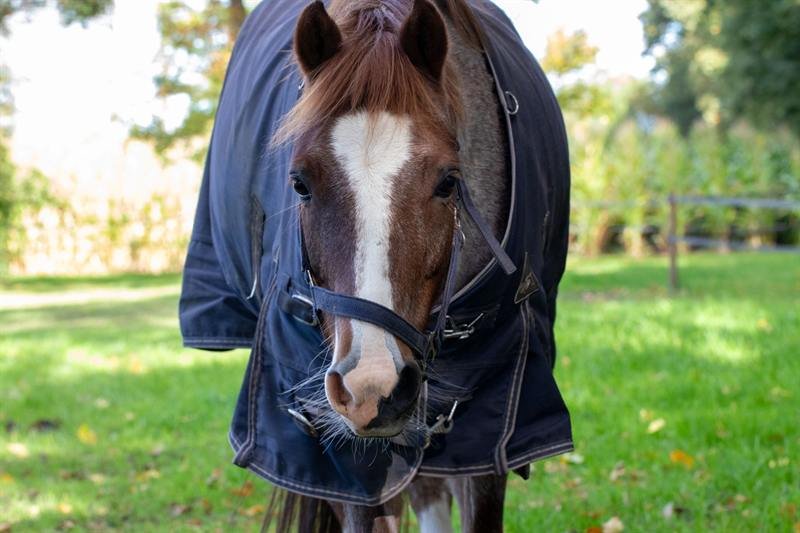
The right horse rug depends on three things: the type (turnout, stable, fleece or sheet), the fill weight and the size, which is measured from the centre of the chest to the point of the buttock where the tail begins, in feet and inches or in centimetres. Get those three right and a rug can last many winters; get them wrong and you risk rubs, chills or a sweaty, miserable horse.
This page is about buying a rug: the types, sizes, fabrics and features to compare. If you want to know when your horse actually needs a rug, and how to put one on and check it day to day, read our guide to rugging.
Types of horse rug
- Turnout rugs: a waterproof, breathable outer shell for use outdoors. They come unfilled (a turnout sheet), lightweight, medium and heavyweight.
- Stable rugs: quilted and not waterproof, designed for indoor use only. They are usually softer and more comfortable for lying down.
- Fleece and cooler rugs: wick moisture away after exercise or a bath, so the horse dries without chilling. They are not for turnout in rain.
- Sheets and rain sheets: unfilled layers that offer light cover or waterproofing in mild, wet weather.
- Under-rugs and neck covers: add warmth in layers, so you can adjust the warmth without buying a full set of rugs in every weight.
- Combo or neck-attached rugs: a neck piece fixed to the rug body, which gives more coverage and is popular for clipped horses.
Stable rug vs turnout rug
The key difference is the outer fabric. A turnout rug is built to cope with rain, wind, mud and being rolled in; a stable rug is not. A quilted stable rug that gets wet loses its insulation and can leave a horse colder than if he had no rug at all, so never use one outdoors. Equally, a turnout rug can be used in the stable, but a heavy waterproof layer may be warmer and less comfortable indoors than a quilted one, so many owners keep both.
Turnout rug weights explained
Fill weight is measured in grams. As a very rough guide, lightweight is around 0 to 100g, medium around 150 to 250g and heavyweight 300g or more. Makers differ, so treat these figures as a starting point and read each product's description rather than relying on the word "medium" alone.
The weight you need depends on the horse more than the calendar. A thin-skinned, clipped Thoroughbred feels the cold far more than a good-doer native with a thick coat.
| Horse | Typical approach to rug weight |
|---|---|
| Unclipped native, good condition | Often no rug, or a lightweight turnout in wet, windy weather |
| Fine-coated or older horse | Medium to heavy in cold spells, with layers to adjust |
| Clipped horse | Heavier rugs plus a neck cover in winter |
| Poor-doer or underweight | Rug earlier to save calories, while monitoring weight |
Buying a lightweight rug plus a separate under-rug or neck cover gives you more flexibility than a single very heavy rug.
How to measure a horse for a rug
- Stand the horse square on level ground, with his head in a natural position.
- Use a soft tape measure and start at the centre of the chest, between the front legs.
- Run the tape along the side of the body, level with the widest part of the shoulder and the barrel, to the point of the buttock where the tail begins.
- Read the measurement in inches (or centimetres) and round up to the nearest rug size. Rugs go up in 3-inch steps.
- Ask a helper to check the tape stays level and does not sag.
If your horse is between sizes, a slightly larger rug that fits well at the shoulder is usually better than a smaller one that pulls across the chest. Rugs are measured from chest to tail in the same way, whichever type you buy.
Horse rug sizes
Rug sizes in the UK are given in feet and inches of body length, with the centimetre equivalent shown below. The horse sizes are only a rough guide, because height does not tell you length; always measure.
| Rug size | Approx. length (cm) | Typical horse or pony |
|---|---|---|
| 4'6" | 137 | Small pony |
| 5'0" | 152 | Pony |
| 5'3" | 160 | Larger pony or small cob |
| 5'6" | 168 | Cob or small horse |
| 5'9" | 175 | Average horse |
| 6'0" | 183 | Average to larger horse |
| 6'3" | 191 | Larger horse |
| 6'6" | 198 | Large horse |
| 6'9" | 206 | Very large horse |
Makers cut differently, so compare each one's sizing chart. Cob-fit or full-cut options exist for broad horses, and some ranges offer extra-deep or high-neck options for deep-bodied or high-withered types.
Materials and denier
Turnout rug outer fabrics are usually made from woven nylon or polyester, and the thickness is given as a denier number, such as 600D or 1200D. A higher denier generally means a tougher, more tear-resistant fabric, which suits horses that play rough, live in with others or are turned out on rough ground. A lower denier is lighter and may be cheaper, but it is more likely to rip.
Denier is only part of the picture. Look also for:
- Waterproof rating and breathability: a breathable fabric lets sweat vapour escape so the horse stays dry underneath.
- Taped or sealed seams: stitching holes let water in unless they are sealed.
- Lining: a smooth, slippery lining helps limit rubbing and hair loss at the shoulder and withers.
- Fill: polyester fill is common; it should stay lofty and spring back after washing.
What to look for when buying
- The correct length, with the front fastening sitting naturally across the chest rather than pulling.
- Room at the shoulders so the horse can lower his head to graze, with no rubbing at the withers.
- A waterproof and breathable shell with taped seams for turnout rugs.
- Strong, stitched fittings: leg straps, a sturdy belly surcingle and tail cord or fillet strings that will not slide or twist.
- A cut that suits your horse's shape, such as a cut-away wither for high-withered types or a gusset for freedom at the shoulder.
- A front closure you can operate easily with cold fingers and a horse that is fidgeting.
- Replacement parts available, such as leg straps and buckles.
- Good quality repairs and re-proofing possible, which extends the life of a good rug.
Safety and fit
A well-fitted rug should not restrict movement or press on the withers and shoulders. Cross-over surcingles should be adjusted so there is a hand's width between belly and strap, and leg straps linked through each other so they cannot trap a hoof. Check for rubbing, hair loss or pressure marks every day, and look for signs of overheating such as sweating under the rug. If your horse shows heat, sweat or restlessness, a lighter rug is likely to suit better. Many owners also carry spare, correctly fitting rugs for sudden weather changes.
Care and maintenance
Brush off dried mud, check for rubs and tears weekly, and swap rugs promptly if they get wet inside. Wash and re-waterproof turnout rugs once a year, ideally in late summer, using a specialist rug wash and proofer rather than ordinary detergent, which can strip the waterproofing. Dry them thoroughly and store in a breathable bag away from damp and rodents. Repair small tears early before they become big ones, and replace worn leg straps and buckles rather than waiting for them to fail on the yard.
FAQs
How do I measure a horse for a rug?
Measure with a soft tape from the centre of the chest to the point of the buttock, level with the widest part of the shoulder, then round up to the nearest rug size.
Can I use a stable rug outside?
No. Stable rugs are not waterproof. They soak up rain, lose insulation and can leave your horse colder than if he were unrugged.
What weight turnout rug do I need?
It depends on the horse's coat, clip, age and condition rather than the date. A lightweight rug suits mild, wet weather; heavier rugs suit clipped or fine-coated horses in the cold.
What does denier mean on a rug?
Denier is a measure of the thickness of the fabric yarn. A higher number usually means a tougher shell, though waterproofing and seams matter just as much.
How do I know if a rug is too tight?
Look for rubbed hair at the shoulder or withers, restricted movement in the front legs or a front fastening that strains. Move up a size or try a different cut.
How often should I wash a turnout rug?
Brush off regularly and wash and re-proof at least once a year, or sooner if it is heavily soiled or no longer repels water.
Useful official resources
- Society of Master Saddlers Find qualified saddle and bridle fitters.
- BETA The British Equestrian Trade Association.
- British Horse Society: horse care and welfare Care advice for horse owners.