
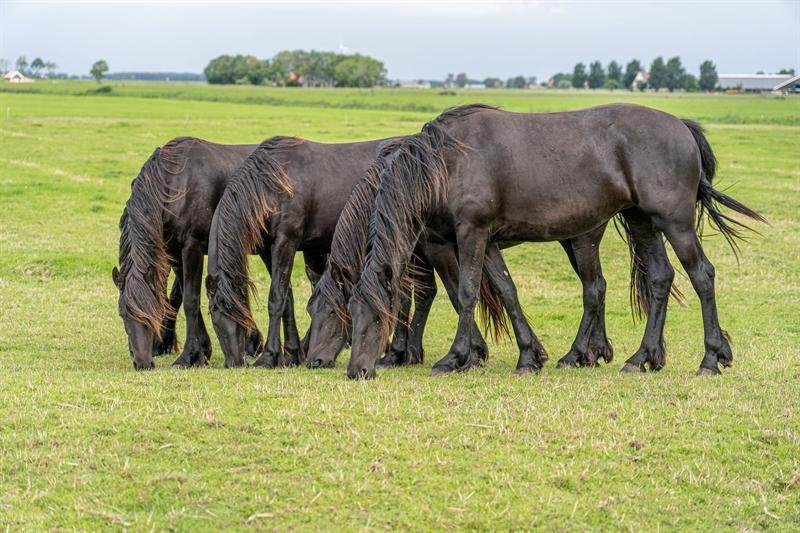
The Friesian horse is a black, long-maned baroque breed from the Netherlands, famous for its high-stepping trot and gentle, people-focused nature. It is a showstopper in harness and under saddle, but it is also a breed that needs informed buyers because of several known health risks and a coat that takes real work to keep in order.
| At a glance | |
|---|---|
| Height | 15.3 to 17 hands |
| Typical weight | Roughly 550 to 680 kg |
| Temperament | Gentle, willing, sensitive, people-oriented |
| Common colours | Black (a small white star is allowed) |
| Best for | Dressage, driving, showing, classical riding, film work |
| Origin | Friesland, the Netherlands |
Friesian horse size and build
Friesians are medium-large horses, typically between 15.3 and 17 hands, with a deep body, strong, arched neck and a small, expressive head. The baroque type is shorter-backed and more compact, while the modern sport type is often taller and lighter. Both have abundant mane and tail, and feathering on the lower legs. Weight is generally in the region of 550 to 680 kg, though condition and type vary.
The action is the breed's trademark: a high-knee trot with great expression and suspension, plus a naturally elevated, rounded outline. That action is part of why Friesians are so popular for dressage and driving.
History of the Friesian
The Friesian is one of Europe's oldest breeds, used in medieval times as a war horse and later as a carriage and farm horse. Numbers fell dangerously low in the early 20th century, and a dedicated stud book, run by the KFPS in the Netherlands, helped save the breed. The UK has an active community of owners and a busy driving and showing scene, and horses come both from British breeders and from imports.
Friesian horse temperament
Most Friesians are kind, calm and eager to work with a handler. They can be sensitive and may sulk or switch off if treated harshly. Many are lazy rather than hot, so they need a rider who can encourage forward movement without constant nagging. They are slow to mature, so they benefit from careful backing, patient conditioning and a long build-up rather than early pressure.
They are often described as thinking, loyal horses that form strong bonds. That makes them rewarding for owners who enjoy time on the ground, but a bored or poorly handled Friesian can become stubborn or pushy simply because it is large and strong. Consistent groundwork helps. See groundwork.
What are Friesians used for?
- Dressage, particularly through the lower and middle levels, where the breed's natural expression helps.
- Carriage driving, singly and in pairs.
- Showing, in-hand, ridden and in harness.
- Leisure riding for steady, competent riders.
- Film, television and display work.
Friesians are not usually bred for fast, sustained athletic work, so they are less common in sports such as eventing. For the sport side, see dressage.
Friesian horse health problems
Several conditions are reported more commonly in Friesians, which is why breed knowledge matters. These include:
- Dwarfism: a condition affecting limb growth, usually obvious in foals.
- Hydrocephalus: a serious developmental problem that can affect foals.
- Megaoesophagus: a condition in which the oesophagus widens and cannot move food properly, causing choke or regurgitation.
- Aortic rupture: a sudden, serious event reported in the breed, more often in some bloodlines.
- Skin problems: a tendency to sweet itch, other skin conditions, and sarcoids.
- Leg and feather problems: heavy feather encourages mud fever and mite infestations.
Ask breeders about screening and family history, and talk to your vet about the breed's particular risks. Not every Friesian will be affected, but buyers should know what to ask. The black coat can also fade and burn in strong sun, and many Friesians struggle in hot weather.
Friesian mane care and feather care
The long mane, tail and feather are a big part of the breed's appeal, and also a time commitment. Friesian mane care starts with being gentle: brush from the ends upwards, use a detangler if needed and avoid ripping through knots. Many owners plait or protect the mane and tail for turnout.
- Pick out feet and check the feather for scabs, heat or swelling.
- Brush out dried mud with a soft brush once the legs are dry. Avoid scrubbing wet mud into the skin.
- Wash only when needed, using a gentle shampoo, and rinse fully so no residue irritates the skin.
- Dry the legs and feather thoroughly, using towels, and keep the horse out of wet, muddy gateways where possible.
- Check the skin under the feather daily. Mites, scabs and sore patches must be seen by your vet if they persist.
Avoid over-washing, which can strip natural oils. Do not trim or clip feather heavily without veterinary advice if there is any skin or leg problem.
Friesian care guide
- Heat and sun: provide shade, good fly protection and consider a sheet or fly rug to reduce sun-bleaching.
- Feeding: some are good doers, so feed according to condition and use forage as the base.
- Exercise: regular, varied work keeps the horse fit and mentally interested. Build fitness gradually.
- Dental and feet: regular dental care and farriery are essential.
- Space and tack: a big horse needs a big stable, secure fencing and well-fitting tack made for a broad, deep frame.
Friesian horse for sale UK: buying guide
Ask for the stud book papers, check parentage and look for a sensible training history. Have a thorough vetting and discuss the breed risks with the vet before you commit. Beware of anyone selling a very young Friesian to a novice with no support, and be wary of horses that are heavily advertised as "pure" but have no verifiable papers.
Prices vary widely depending on grading, age, training and bloodline, and are typically higher than for many native breeds. Treat any figures as a guide only and shop around. You should also budget for feed, farriery, transport and insurance. Insurance may exclude or limit certain breed-linked conditions, so read the policy carefully. See insurance.
Buyer's checklist
- Registered papers and passport that match the horse and its microchip.
- Family history and any DNA or screening results the breeder can provide.
- Clear skin and clean legs with no scabs or swelling under the feather.
- Calm, willing behaviour on the ground and under saddle.
- A written insurance quote that lists exclusions.
FAQs
Are Friesians good for beginners?
Many are gentle, but their size, sensitivity and care needs make them better for confident owners with support.
Why is the Friesian always black?
Breed standards require black, with only a small star permitted. The colour is part of the registration rules.
How big is a Friesian horse?
Most stand between 15.3 and 17 hands and weigh roughly 550 to 680 kg, though type and condition vary.
Do Friesians have health problems?
Some conditions are reported more often in the breed, including dwarfism, megaoesophagus and aortic rupture. Many Friesians live healthy lives, but buyers should ask about screening and family history.
How do you look after a Friesian's mane?
Brush gently from the ends up, wash only when needed, avoid breaking the hair and keep it clean and tangle-free, often by plaiting it for turnout.
Can Friesians be ridden?
Yes. They are used for dressage and leisure riding, as well as driving. Allow plenty of time for a young horse to mature.
Useful official resources
- The British Horse Society Owning and caring for horses of every type.
- World Horse Welfare Rehoming and welfare charity.