
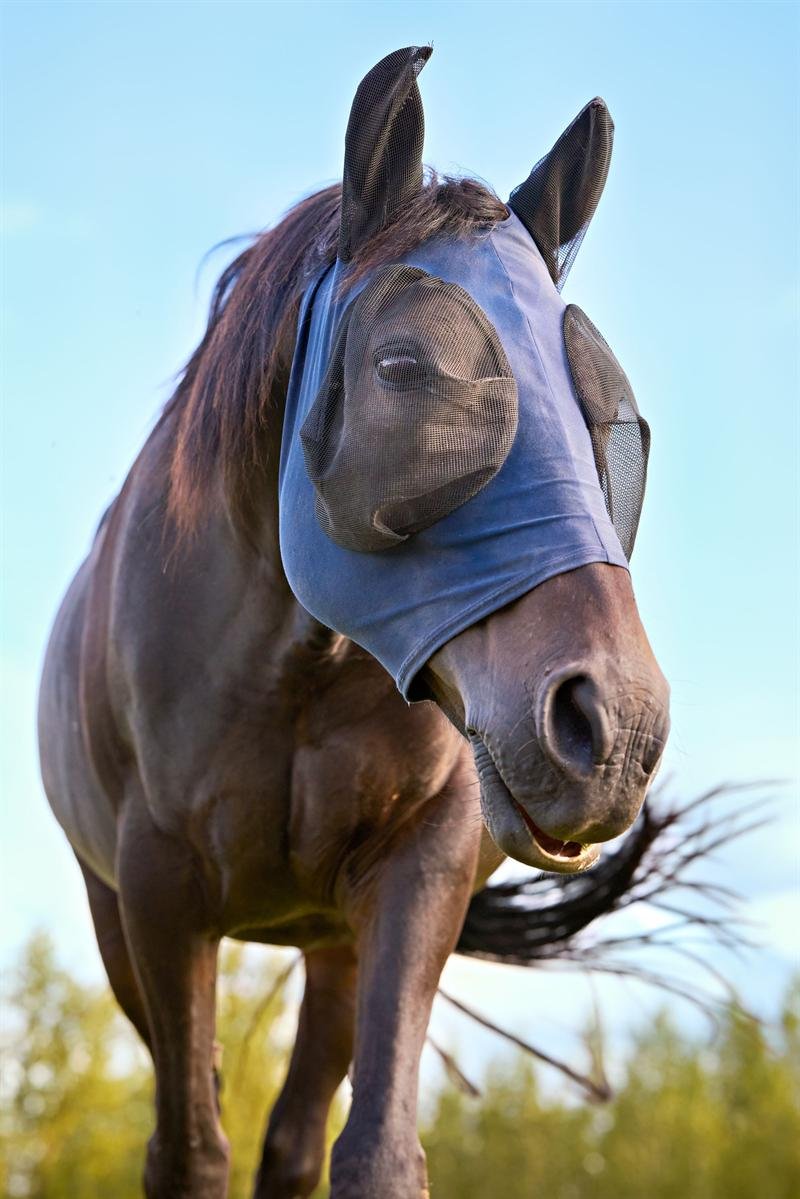
A horse fly mask shields your horse's eyes, and often his ears and muzzle, from flies, grit and sunshine, and for horses prone to watery eyes or photosensitivity it can make summer far more comfortable. Choose a lightweight mesh that fits snugly without rubbing, remove it daily to check the eyes, and wash it often.
Fly masks for horses are one part of a wider plan. For repellents, rugs, turnout timing and stable management, see our guide to fly protection.
Types of fly mask
- Eye-only masks: mesh over the eyes, light and cool. A good starting point for most horses.
- Fly mask with ears: a fabric or mesh ear cover that keeps flies and midges out of the ears. Useful for horses that shake their heads or are bothered by insects around the ears.
- Masks with nose protection: an extended muzzle section for pink-nosed or sunburn-prone horses.
- Fringed or gnat-style masks: add fine fringing for insect-heavy places, such as near water or woodland.
- Fly hoods: cover the whole head and neck, sometimes used for horses with sweet itch around the head and ears.
- Combination masks: a mask with a detachable ear section or nose piece, so you can adapt it to the weather.
UV fly masks and eye protection
Most meshes block a proportion of ultraviolet light, which is helpful for horses with pale skin around the eyes, those with certain eye sensitivities and horses that squint in bright sun. A UV fly mask for a horse is not a medical treatment, though. If your horse has watery, cloudy or sore eyes, or a history of recurrent eye problems, your vet can advise what is suitable. See our guide to eye problems.
The mesh also helps keep grit, hay dust and seeds out of the eyes, and reduces the irritation from flies that feed on tear fluid.
Sizing and how to fit a fly mask
Masks are typically sold in sizes such as pony, cob, full and extra full. Compare your horse's head measurements with the maker's chart: the usual ones are the length of the face from poll to nose and the distance around the head at the cheekbone. Sizes are only a guide, as head shapes vary, so try a mask on in the stable first. A good fit has these features:
- The mesh sits clear of the eyeball, so lashes do not touch it.
- You can fit a finger under the noseband and cheek straps with ease.
- It stays put when he grazes, rolls and shakes his head.
- The ears sit naturally in the ear covers without being squashed or folded.
- No hair is rubbed at the cheekbone, forelock or bridge of the nose.
Fasten the mask on the first time under supervision, and recheck the fit after a few days of turnout, as hair can flatten and straps can slip.
Materials and design
Most masks are made from a knitted or woven mesh, edged with soft fleece or neoprene-style binding. A finer mesh gives better protection from small insects but can reduce visibility, while a more open mesh is cooler and clearer. Look at the mesh from the horse's side: the best designs let him see well in all directions. Darker meshes can be easier to see through than pale ones; brighter outer colours are easier for you to spot in a field.
Fastenings are usually hook-and-loop. These should hold firmly but release if the mask is caught on a branch or fence. Elastic panels also add give. Avoid heavy buckles or rigid fittings near the face.
What to look for when buying
- A soft edging that will not rub across the nose, cheeks or forelock.
- Fine mesh with good visibility from inside; some are surprisingly cloudy.
- A fastening that releases under pressure, or elastic panels that can give if caught.
- Machine-washable materials that keep their shape.
- Contoured eye cups or a structured shape if your horse is sensitive to lashes touching the mesh.
- Ears and nose sections that are removable if you want flexibility.
- Bright colours for easy spotting if it is lost in the field.
- Good size availability, so you can find a proper fit rather than making do.
Care and maintenance
Dirty masks collect sweat, dust and fly debris that irritate eyes, so rinse regularly and wash every week or two in summer. Use mild, non-biological detergent, rinse thoroughly and air dry out of direct heat. Check seams for damage and fastenings for clogging with hair. Replace torn mesh immediately, because a ripped section can scratch the eye. Store flat so the shape does not distort, and keep them away from damp, which can lead to mould.
If you share masks between horses on a yard, wash them between uses. Skin infections, ringworm and eye infections can pass from horse to horse on shared kit.
Introducing a fly mask to your horse
Most horses accept a mask without fuss if you take it slowly. Let him sniff it first, then rub it gently along his neck and face so he sees it is harmless. Fit it in the stable rather than the field, where he cannot bolt off if he is worried. Fasten it loosely at first, then adjust, and stay with him for the first few minutes. Turn him out for a short spell on the first day and check it again afterwards.
Young or nervous horses may take several sessions. If your horse panics, rubs frantically or pulls at it, take it off and try again with a softer, better-fitting design rather than forcing the issue.
When a fly mask is not enough
A mask protects the head, but flies also bother the belly, legs and body. For many horses the best results come from combining a mask with a fly rug, sensible turnout times, tidy fields and repellent where appropriate. Horses with allergic skin disease may need a tailored plan from the vet. Keep an eye on your horse's behaviour: a horse that is still stamping, tail-swishing and head-shaking despite a mask may need more help than a mask can give. Our fly rugs guide covers the next layer of protection.
FAQs
Can a horse wear a fly mask all day and night?
Most horses tolerate it by day. Night use varies by mask and horse, so check the manufacturer's guidance and your horse's comfort, and choose a mask designed to release if caught.
Do I need a fly mask with ears?
Not always. It helps horses bothered by flies and midges around the ears, but some horses dislike having their ears covered, so introduce it gradually.
Will a fly mask stop sweet itch?
It helps protect the face and ears, but sweet itch needs wider management. See our guide to sweet itch.
My horse rubs his mask off. What should I do?
Check fit and rubbing first. A mask that is too tight or irritating will prompt rubbing; try a different cut or a softer lining.
Does a UV fly mask protect against sunburn?
It can reduce the sun reaching the eyes and, with a nose section, the muzzle, but it does not replace veterinary advice for pale-skinned or sensitive horses.
How often should I clean a fly mask?
Rinse after muddy or sweaty days and wash every week or two in summer, or whenever it looks or smells dirty.
Useful official resources
- Society of Master Saddlers Find qualified saddle and bridle fitters.
- BETA The British Equestrian Trade Association.
- British Horse Society: horse care and welfare Care advice for horse owners.