
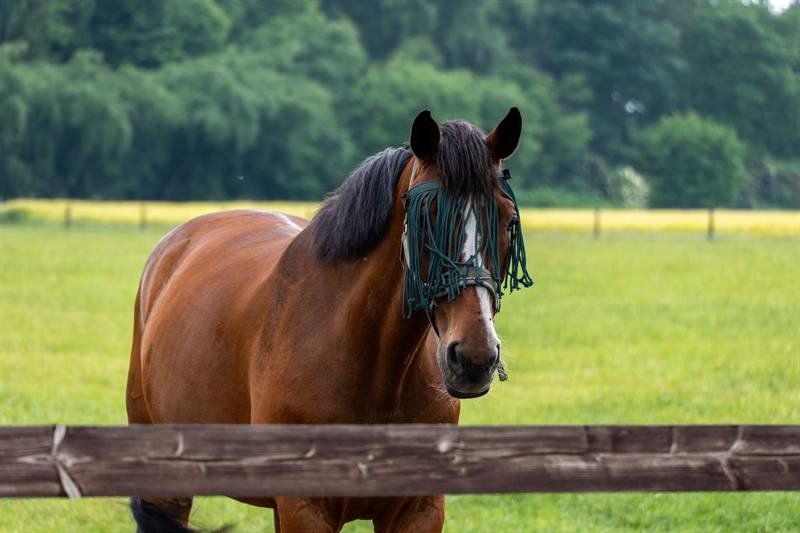
Fly rugs for horses are lightweight, breathable covers that keep flies, midges and the sun off the coat, and for sweet itch sufferers they are often a key part of management. Measure from the centre of the chest to the point of the buttock, choose a mesh suited to the insects where you live, and fit it so it does not rub at the shoulders or withers.
Types of fly rug
A fly sheet for a horse is not one product but a family of designs. The right one depends on what you are protecting against and how your horse lives.
- Standard mesh fly sheet: loose-weave mesh that deters flies and keeps dust off. Often used with a fly mask.
- Combo or neck-attached rug: includes a neck cover to protect the crest, mane and withers.
- Sweet itch rugs: finer, higher-cover designs with a belly flap, neck, hood options and tail flap, aimed at midge protection.
- UV-protective rugs: help horses prone to sunburn or those with photosensitivity, such as those with pink skin.
- Cooling or sheen rugs: often used for travelling or after work rather than turnout.
Standard meshes stop larger flies but are less effective against midges, which are tiny. For horses that react badly to Culicoides midges, choose a finer-woven design and combine it with turnout management; see sweet itch for more.
Sweet itch rugs: what makes them different
A sweet itch rug is built to cover the areas midges bite most, which typically means the mane, withers, back, tail head and belly. Look for a full neck or hood, a belly protector that fastens securely, and a tail flap or tail piece. The fabric is a tighter mesh than a standard fly sheet, which is why these rugs can feel warmer in hot weather.
A rug helps, but it is rarely enough alone. Management that many owners combine with a rug includes stabling or bringing the horse in during dawn and dusk, when midges are most active, choosing breezy, drier grazing away from standing water, and speaking to your vet about skin care. Seek veterinary advice early, as broken, weeping skin can become infected. The aim is to prevent the itching in the first place, because a horse that has rubbed himself raw is much harder to help.
How to size a fly rug
- Stand your horse square on level ground and use a soft tape measure.
- Measure from the centre of the chest, straight along the side of the body, to the point of the buttock.
- Convert to feet and inches and choose the nearest size up, typically in 3-inch steps.
- Check shoulder room, since fly rugs should still allow free grazing movement.
- Look for clear space between the rug and the withers to avoid rubbing.
If your horse is between sizes, a slightly snug fit is better than a loose one, because loose rugs flap, slip and tangle. Cut-away withers help high-withered types, and different brands cut differently, so always check the maker's size guide. Remember that a horse in rug-weight condition changes shape through the season.
| Fit check | Good sign | Warning sign |
|---|---|---|
| Shoulders | Free movement when walking and grazing | Rubbing, hair loss or a rug pulled back |
| Withers | Clear space beneath the rug | Pressure marks or sore skin |
| Chest | Fastens easily with a hand's width of room | Gaping or pulling tight |
| Belly straps | Secure and not slipping back | Rubbing at the flank or girth area |
| Length | Covers to the tail head | Too short, leaving the rump exposed |
What is the best fly rug?
There is no single best fly rug, only the best one for your horse, climate and purpose. A native pony on a breezy hillside has different needs from a clipped sports horse in a midge-heavy valley. Think about the main problem first, whether that is flies, midges, sun or all three. Then look at fit, durability, and how easily you can wash and repair it. Many owners keep two rugs so one can be washed and dried while the other is in use.
What to look for when buying
- Mesh fine enough for the insects in your area, with strong seams.
- Quick-release front fastenings and secure belly straps that will not slip.
- Soft lining at the shoulder and wither to prevent rubbing.
- Leg straps or a fillet string if the rug tends to blow around.
- Detachable neck and belly pieces for flexibility.
- Light colours reflect heat and tend to run cooler.
- Generous cut at the shoulders so the horse can graze, roll and stretch comfortably.
Safety and comfort
Check your horse at least once a day while he is wearing a fly rug. Look for rubbing, sweating, slipped straps and any signs he is too hot. Make sure the rug is not caught on fencing or gateposts, and that loose straps are not dangling where a hoof could catch them. Take the rug off on very hot days if your horse is overheating, or if you cannot check him regularly. Horses in lighter mesh rugs can still sunburn in places, particularly around the muzzle, so ask your vet or an experienced yard friend about sun protection for pink skin.
Care and maintenance
Dirt, grease and sweat clog the mesh and weaken it, so wash the rug every few weeks during use. Use a mild detergent, rinse well and dry thoroughly. Check straps for stretching and brush mud and hair from the Velcro. Sun exposure can degrade fabric over time, so store the rug clean and dry away from direct light in winter. Repair small tears before they enlarge, as a torn mesh can catch a hoof or a buckle.
When to put a fly rug on and take it off
Most owners start using fly rugs when insects first appear in spring and keep them until the first frosts, although the timing varies by region and season. Midges are often worst around dawn and dusk and on still, humid days, so those are the times to be most careful. A rug is no use if it sits in the tack room while the horse is being bitten, but it is also no use if it is so warm that the horse sweats. Be ready to change rugs through the day if the weather turns, and never leave a horse in a rug you cannot check regularly.
FAQs
Can a fly rug cause overheating?
Mesh rugs are breathable, but dark, heavy designs in hot weather may increase heat. Watch for sweating and remove it in extreme heat.
Do I need a fly rug and a fly mask?
Not necessarily, but they work well together, since the rug covers the body while the mask protects the face. See fly masks.
Will a fly rug stop all insect bites?
No rug is a complete barrier, so use stable timings, fly repellents and good field management as well. See fly protection.
What size fly rug does my horse need?
Measure from the centre of the chest to the point of the buttock and choose the nearest size up from the maker's size chart.
Is a sweet itch rug worth buying?
For a horse that is bitten by midges and itches, it can make a real difference, ideally alongside management changes and veterinary advice.
Can a horse wear a fly rug overnight?
Many do, but check the weather. In cool, damp UK nights a thin mesh rug may not be warm enough, so be ready to adjust.
How often should I wash a fly rug?
Every few weeks in regular use, or sooner if it is dirty, sweaty or smells.
Useful official resources
- Society of Master Saddlers Find qualified saddle and bridle fitters.
- BETA The British Equestrian Trade Association.
- British Horse Society: horse care and welfare Care advice for horse owners.