
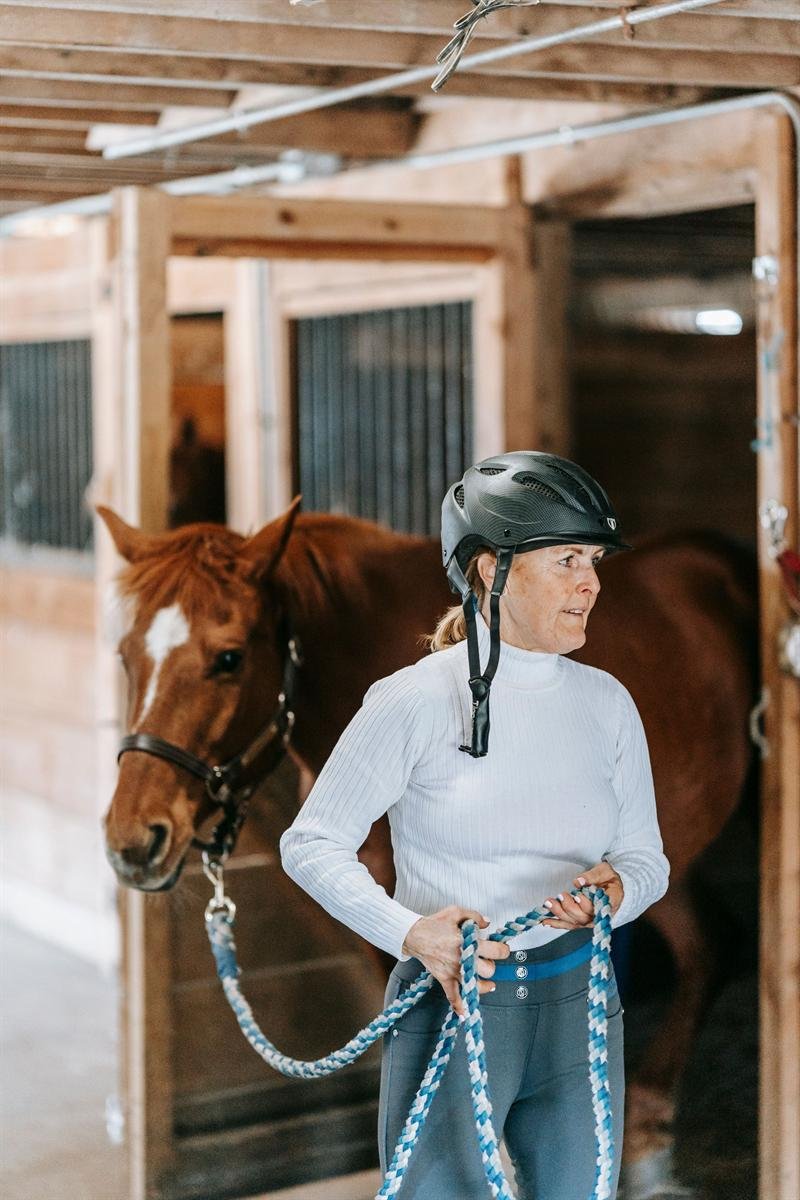
A good horse lead rope is long enough to give your horse room to move, strong enough to hold him if he spooks, and comfortable enough for your hands. Most people do well with a rope of about 2 to 2.5 metres (6 to 8 feet) with a reliable clip, checked regularly for wear.
How long should a lead rope be?
Lead rope length is a trade-off. Shorter ropes keep a horse close but leave little room for error and can pull on the headcollar if he lifts his head; longer ones allow grazing and in-hand work but are more likely to tangle round legs or hands. For general leading and tying up, 2 to 2.5 metres is a safe compromise for most horses and handlers.
| Length | Best for | Watch out for |
|---|---|---|
| Around 1.8 to 2 metres | Ponies, quiet leading, tying in the stable | Little give if the horse spooks |
| Around 2 to 2.5 metres | General use for most horses | Coil excess neatly so it does not drag |
| Around 3 metres or more | Grazing in hand, trekking, in-hand showing at some events | Tripping or tangling; not for tying up |
For lunging-style or training work, longer lines are separate kit. See lunging and groundwork for those.
Lead rope materials
The material changes how the rope feels in the hand and how it copes with rain, frost and mud.
| Material | Pros | Cons |
|---|---|---|
| Cotton rope | Soft on hands, easy to knot | Can absorb water, rot or shrink |
| Polyester or polypropylene | Strong, weather resistant, dries quickly | Can burn through hands if pulled |
| Webbing | Flat, smooth in hand, washable | May be stiff when wet |
| Leather | Hard-wearing and attractive | Needs care and conditioning |
Many yards keep a soft, thick rope for everyday handling and a stronger spare for travelling. Thin ropes are harder to hold and more likely to cut into your hands if the horse pulls back.
Lead rope clip types
The clip is the part most likely to fail, so it deserves as much thought as the rope itself.
- Trigger clips: reliable and common, but can be fiddly with cold hands.
- Bolt snaps: simple, hard-wearing designs, good for everyday use.
- Panic or quick-release clips: open under pressure even when the horse pulls back. Useful in some situations, but they must be well made and you should be aware that they can release at a moment when you would rather they did not.
- Chain-end ropes: add control but should be used with training and care, and only by those who understand how to use them without causing pain or fear.
Whichever you choose, the clip should be solid metal with no visible cracks, a smooth action and a spring that closes firmly. Swivel clips reduce twisting but add weight, so they suit longer ropes better than short ones.
Quick release lead ropes and safe tying
A quick release lead rope helps in an emergency, but it is no substitute for safe tying habits. If a horse sets back and panics, he can injure his neck, poll or back, and he can hurt people nearby.
- Tie to a strong fixed point at about eye height or slightly above, never to a gate, rail or anything that could move.
- Use a quick-release knot you can undo with one pull, even when the rope is tight.
- Attach the rope to a loop of breakable twine rather than a fixed ring, so the horse can free himself if he panics.
- Leave enough slack for the horse to lower his head but not so much that he can step over the rope.
- Never leave a horse tied unattended, and keep your own body out of the line of a pull-back.
- Do not tie with a rope attached to a headcollar that has no breakable fitting if you can help it.
If your horse regularly sets back or panics when tied, treat it as a training and welfare issue rather than a kit problem and ask a qualified trainer or experienced instructor for help. See horse behaviour for related guides.
What to look for when buying
- A thick enough rope for a comfortable grip, typically at least 12 mm for a horse.
- Strong stitching and a protective whipping at the rope end, so it does not fray.
- A clip that opens smoothly yet closes securely, with no sharp edges.
- Appropriate weight, as heavy clips can bang on a pony's face.
- Bright colour for easy spotting if dropped in the dark or the field.
- A spare rope for travelling and the stable, so you never have to improvise.
Leading safely
Walk beside your horse's shoulder, not in front, with the rope held in a neat bundle in your free hand and the working hand a short distance below the clip. Do not allow the rope to trail on the ground, where it could catch a leg. Wear sturdy boots and a hat for in-hand work with young or excitable horses. When turning out, face the gate after closing it, unclip calmly and let the horse go, rather than letting him pull away. More tips are in our riding safety guide.
Lead rope or headcollar rope: do I need both?
Many headcollars come with a matching rope, but it is worth keeping a few spare ropes of different types. A short, light rope suits quick trips to the field, while a longer, stronger one suits travelling and trekking. A rope kept permanently on a headcollar left on a horse in the field is a hazard, as it can snag. Where a horse must wear a headcollar in turnout, use a breakable one with no rope attached. See headcollars for choosing a safe, well-fitting one.
Choosing a rope for different horses
- Ponies and children's ponies: a lighter rope and a small clip, so the weight does not annoy the pony or knock his face.
- Strong or excitable horses: a thicker, softer rope that is comfortable to hold firmly, and good gloves.
- Young or green horses: a rope you can handle confidently, and an experienced person helping with early handling.
- Horses that load or travel: a strong spare rope kept in the lorry, so you are never short.
Care and maintenance
Wash fabric ropes in warm water, dry them fully and hang them to keep their shape. Check clips regularly for stiffness, rust or cracks, and add a little lubricant to hinges if they stick, wiping off any excess. Inspect for fraying near the clip, where the rope takes the most strain. Replace immediately if the core is exposed, because it could fail at the wrong moment. Do not store wet ropes in a heap, as they can rot.
FAQs
How long should a lead rope be?
Around 2 to 2.5 metres works for most horses and handlers.
Can I use a lead rope to tie up my horse?
Yes, with a quick-release knot and a safe tie ring set at a sensible height. Use breakable twine as a failsafe.
When should I replace a lead rope?
When it shows fraying, stiffness, cuts or a weak clip. If in doubt, replace it, as the cost is small compared with an accident.
What is the best clip for a lead rope?
A well-made bolt snap or trigger clip suits most people. Choose one you can operate easily with gloves on.
Are quick-release lead ropes safe?
They can help in an emergency, but they should be well made and used with safe tying habits, not instead of them.
Is a chain on a lead rope cruel?
Not if used correctly by someone trained, but it can cause pain if used harshly. Many horses never need one. Ask an experienced instructor.
Useful official resources
- Society of Master Saddlers Find qualified saddle and bridle fitters.
- BETA The British Equestrian Trade Association.
- British Horse Society: horse care and welfare Care advice for horse owners.