
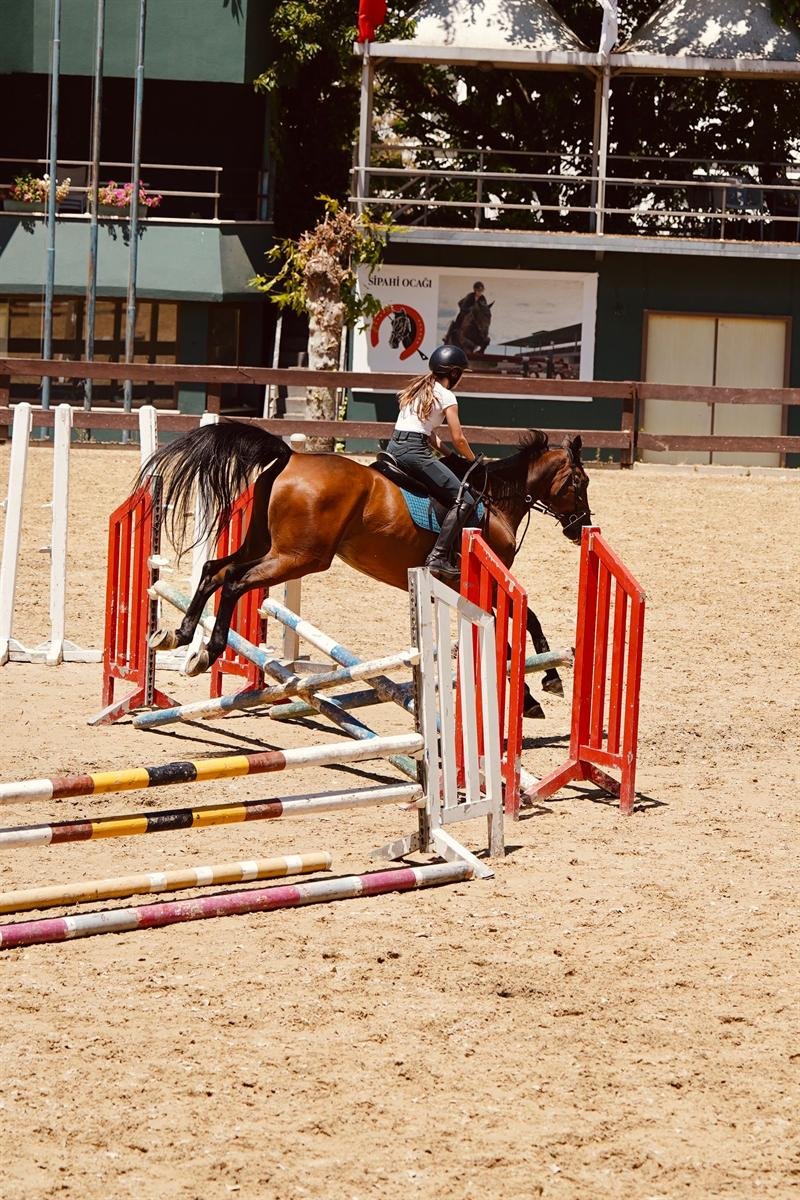
Show jumping for beginners is about riding a course of fences cleanly and within the time, and learning how to show jump starts on the flat. A balanced canter with a steady rhythm will do more for your results than height or bravery, so build up gradually through poles, grids and small courses with a good instructor on the ground.
What is show jumping?
In show jumping, horse and rider jump a numbered course of coloured fences in a set order. The aim is to leave every fence standing and finish within the time allowed. It rewards accuracy, rhythm and a partnership built on trust, and it can be enjoyed at every level, from a clear-round class over cross-poles to national competition.
You do not need a natural jumper to enjoy it. Many horses and ponies that are not built for height still make careful, willing jumpers over modest fences, and a rider with a secure position and good judgement of stride will often outscore a bolder partnership.
Before you start: flatwork first
Jumping exposes weaknesses on the flat. Before you point at a fence, check that you can ride:
- a balanced, rhythmic canter on both reins, on a circle and a straight line
- smooth transitions without rushing or leaning
- a secure, independent position in two-point (jumping) seat, with a still lower leg; see riding position
- the ability to steer and stop reliably; see horse control
If any of these are shaky, spend more time on them. Our guide to schooling for riders has exercises that help.
Show jumping technique: the jump in five phases
- Approach: a straight line to the middle of the fence, in a rhythmic canter, looking up to where you want to go.
- Take-off: the horse lifts and you fold forward from the hips, keeping your lower leg still and your heels down.
- Flight: follow the horse's neck with your hands, giving enough rein so you do not catch him in the mouth. Many riders hold a neck strap or a piece of mane while learning.
- Landing: keep your weight in your heels, sit up and look to the next fence.
- Getaway: re-establish a balanced canter and plan the next turn.
Stirrups for jumping are usually shortened by a few holes from flatwork length, which helps you stay light over the horse's back. Your position should stay secure and balanced; the horse does the jumping, and your job is not to get in his way. Common faults to work on with your instructor include getting ahead of the movement, dropping back too soon, a swinging lower leg and hanging on the reins.
Building up safely: poles, grids and courses
- Poles on the ground: trotting poles teach rhythm and accuracy for both horse and rider.
- Cross-poles: the first small fence, which encourages the horse to jump in the middle.
- Grids and gymnastic lines: a series of fences set at fixed distances helps the horse learn to use himself and the rider to stay with the movement. Gridwork for horses is powerful but only as safe as the distances, so have an experienced instructor set them for your horse's stride.
- Single fences, then small courses: turns, related distances and changes of direction.
Keep fences small until the basics are secure, and avoid drilling a horse repeatedly, as sour, tired horses start to refuse. Jump once or twice a week at most for most horses, with plenty of flatwork and hacking between sessions; see hacking.
| Stage | What to practise | Move on when |
|---|---|---|
| 1. Ground poles | Trot over single poles and a line of poles | Horse stays straight and in rhythm; you stay balanced |
| 2. Cross-pole | Approach in trot, then canter, over a tiny fence | Both sides, calm approach and landing |
| 3. Small grid | Pole to cross-pole to small upright, set by your instructor | Horse is relaxed and you keep your position |
| 4. Single fences | Different types, from different directions | Consistent rhythm and straight lines |
| 5. Short course | Four to six fences with turns | You ride the plan, not the fear |
Show jumping rules in the UK
In a clear-round class you simply complete the course, which makes it an ideal first outing. In jumping competitions, each knockdown or refusal normally incurs penalty faults (usually four for a knockdown), and a second refusal costs more. A fall or a third refusal usually means elimination, and time faults are added if you go over the time allowed. A jump-off, over a shortened course against the clock, decides ties.
Rules differ by class, height and organiser, and they are updated, so read the current rulebook of the governing body, British Showjumping, before you enter. See British Showjumping for membership, and competition rules for general guidance. Walk the course on foot first, noting turns, distances and the order, and ask the steward if you are unsure.
Start show jumping: your first competition
Choose a friendly local venue or a riding club show for your first outing. Arrive early, give your horse time to look around, and warm up over a small practice fence. Aim to have a positive experience rather than a rosette. Take someone to help on the ground, and be ready to retire politely if your horse becomes unsettled. Your loading should be reliable before you travel.
Safety first
Wear a hat to a current standard, such as PAS 015 or VG1 01.040, ideally with an independent certification mark, fitted properly with the harness fastened. Replace it after any fall or knock. Consider a body protector, and check your organiser's rules, since some require one for particular classes. Check that cups, poles and wings are sound, with no splintered or broken equipment, and use safety cups where they are required. Jump only with someone on the ground whenever possible, and never jump a tired horse or on poor footing. Boots for protection are covered in horse boots, and wider advice is in riding safety.
If your horse keeps stopping or knocking poles
Do not assume it is naughtiness. Pain is a common reason for stopping, so check teeth, back, feet and saddle fit; see lameness and saddles. Then look at your own riding: backing off at the last moment, restricting with the reins or riding a poor line all invite a stop. Drop the fences, rebuild confidence with poles and grids, and consider a few lessons.
FAQs
When can I start jumping?
When you have a secure, independent seat at walk, trot and canter and your horse is balanced and sound. Your instructor will advise.
How high should a beginner jump?
Small. Stay with cross-poles and low uprights until you and your horse are confident and relaxed, then raise fences gradually.
Why does my horse stop at fences?
Causes include pain, loss of confidence, rider hesitation or a lack of preparation. Go back to smaller fences, have your horse checked and examine your own approach too.
How many strides should there be between fences?
It depends on the distance and your horse's stride length. In grids and lines, your instructor will set the distances to suit your horse, and on a course you learn to adjust your canter.
Do I need to join British Showjumping to compete?
Not for unaffiliated and many local shows, but you need membership for affiliated classes.
How often should I jump my horse?
For most horses, once or twice a week is plenty, with flatwork and hacking in between to avoid wear and boredom.
Useful official resources
- The Highway Code: rules for horse riders (gov.uk) Rules 47 to 58 for riding and leading horses on the road.
- The British Horse Society Riding, safety and access advice.
- British Riding Clubs Training and competition for adult riders.