
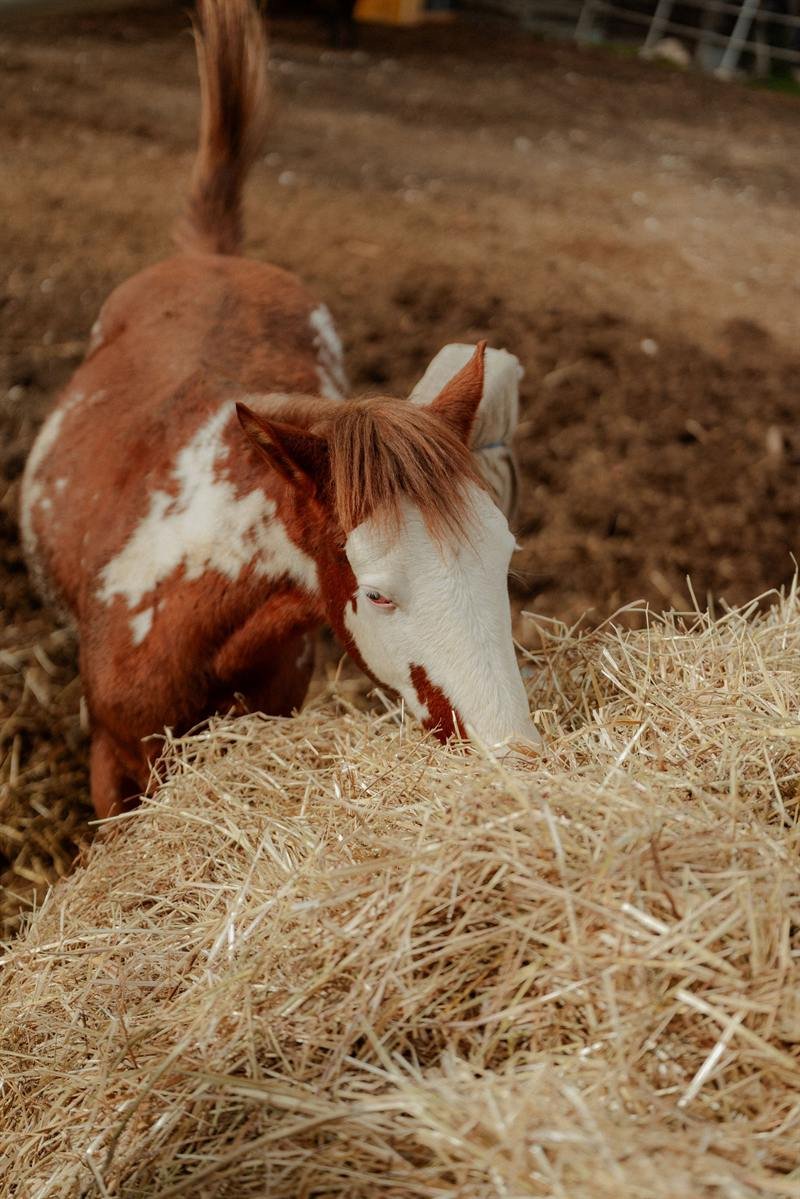
Feeding hay to horses starts with quality and quantity: hay is dried grass, and for most stabled horses in the UK it is the foundation of the diet. Good hay is dry, sweet-smelling, free from mould and dust, and fed in quantity, usually at least 1.5% of bodyweight in dry matter a day, which for a 500kg horse is roughly 8–9kg of hay as fed.
How much hay does a horse need?
Horses are trickle feeders designed to eat for many hours a day, so forage should make up most or all of the diet. A common guide is 1.5–2.5% of bodyweight in dry matter a day, which works out at about 8–14kg of hay as fed for a 500kg horse, depending on the rest of the diet, workload and condition. Hay is usually around 85–90% dry matter, which is why the "as fed" weight is slightly higher.
| Horse | Rough daily hay as fed |
|---|---|
| 12hh pony, about 250kg | Roughly 4–6kg |
| 14hh pony, about 400kg | Roughly 6–10kg |
| 16hh horse, about 500kg | Roughly 8–14kg |
| 17hh horse, about 600kg | Roughly 10–16kg |
These are guides only. Good-doers on a weight-loss plan need a vet-supervised or nutritionist-supervised reduction rather than a sudden cut, as horses should never be starved of forage. Weigh a few nets to see what you really feed, and use our feeding charts and weight loss guide to plan.
Types of hay and the best hay for horses
There is no single best hay for every horse. Meadow hay is cut from permanent pasture and contains a mix of grasses and herbs. It is usually the most widely available, varies a lot from field to field, and is often more palatable to fussy eaters. Seed hay is cut from a sown ley of fewer grass species, giving more consistent but often richer forage. Timothy and other specific grass hays are sold in smaller quantities, mainly by the bale or bag.
Later-cut hay is generally more mature, lower in protein and sugar, and often suits good-doers and native types. Early-cut hay is leafier and richer, which suits horses in harder work or those needing to hold weight. Hay analysis can tell you more, as appearance and smell tell you condition but not sugar or protein content. For horses that struggle to keep weight, see weight gain; if hay is not suitable, haylage is an alternative.
Feeding hay: practical tips
Feed hay little and often, and avoid long gaps without forage, as an empty stomach can contribute to ulcers and boredom. Many horses do best with hay available through the night. Slow feeders, small-holed nets and multiple piles around the stable all make hay last longer. Feeding from the floor is more natural and kinder to the airways, but it can waste more and is less suitable on sandy ground. Always make sure water is available, as horses eating hay drink more.
When you change hay, do it gradually over a week or more, mixing old and new to avoid digestive upset. Weigh the hay at the start of each batch, as bales vary, and recheck your horse's condition regularly by eye and with a weigh tape.
Judging hay quality
- Smell: sweet and fresh, never musty, sour or mouldy.
- Colour: pale green to golden is fine; bleaching on the outside is normal, but brown or black patches inside are a concern.
- Dust: shake a handful in good light; a cloud of grey or white dust means fungal spores, a problem for horses with respiratory problems.
- Contents: reject hay containing ragwort (which stays toxic when dried), thistles in quantity, or other weeds, plus any mould or foreign material.
- Texture: not too coarse and stemmy, with leaf still present.
Soaking hay for horses
Soaking is used for horses on a low-sugar diet, such as those with laminitis or insulin dysregulation: your vet will usually suggest around 12 hours in cold water, which can reduce water-soluble carbohydrate but also leaches some vitamins and minerals, so a balancer is often needed. Soaking also removes some dust. How much sugar is removed varies with the hay, so ask your vet or nutritionist, and consider testing hay if you manage laminitis.
- Use a clean container or net in a bucket or tub, with plenty of cold water.
- Fully submerge the hay for the time your vet advises, rather than guessing.
- Drain thoroughly, ideally for a short time.
- Feed promptly, particularly in warm weather, because soaked hay ferments quickly.
- Dispose of the dirty water away from drains and watercourses, as it can pollute them.
Steaming hay
Steaming in a purpose-made steamer reduces dust and mould spores while keeping most nutrients, and is generally preferred for horses with respiratory sensitivity. It does not remove sugar in the way soaking does.
How to store hay
Store bales off the floor on pallets, in a dry, well-ventilated barn separate from the stables, as this reduces fire risk and spore exposure in the yard. Keep stacks stable and don't pack bales tightly against walls. Fresh hay is best left to mature for a few weeks after baling, and many people prefer to wait until it has finished sweating. Check for moisture and heat when you open each stack, and use older hay first. Keep the store clear of rodents and bird droppings, and take care with moist hay, which can heat up and, in rare cases, catch fire.
What to look for when buying
- See and smell the hay before agreeing a price, or buy a trial bale.
- Ask when and where it was cut, how it was made, and whether it was rained on.
- Ask for a hay analysis if you manage laminitis, insulin dysregulation or weight issues.
- Check that bales are a consistent weight and size: heavy bales may be damp.
- Buy enough from one cut to last the winter, so you can avoid sudden changes mid-season.
- Check delivery, stacking and storage arrangements; prices vary by region and by season.
FAQs
How much hay should a horse eat a day?
Roughly 1.5–2.5% of bodyweight in dry matter; as fed, that is about 8–14kg for a 500kg horse, depending on the rest of the diet and condition.
Can I feed hay straight after baling?
It is usually best to leave it for several weeks, because new hay can be undigestible in quantity and may cause loose droppings.
Should all hay be soaked?
No. Soak or steam only where there is a reason, such as dust sensitivity or a low-sugar diet, and take advice from your vet or a nutritionist.
How long should I soak hay?
For a low-sugar diet, vets commonly suggest around 12 hours in cold water. Follow your own vet's advice.
Is hay or haylage better?
Neither is better for every horse. Hay is usually lower in sugar and cheaper, while haylage is less dusty but richer, so choose by the individual horse's needs.
Can horses eat mouldy or dusty hay?
No. Mouldy hay can cause colic and respiratory problems, so discard it. Dusty hay should be steamed or replaced.
Useful official resources
- World Horse Welfare: advice Body condition scoring and feeding guidance.
- British Equine Veterinary Association The professional body for equine vets.
- Code of Practice for the Welfare of Horses (gov.uk) Legal standards for feeding and care.