
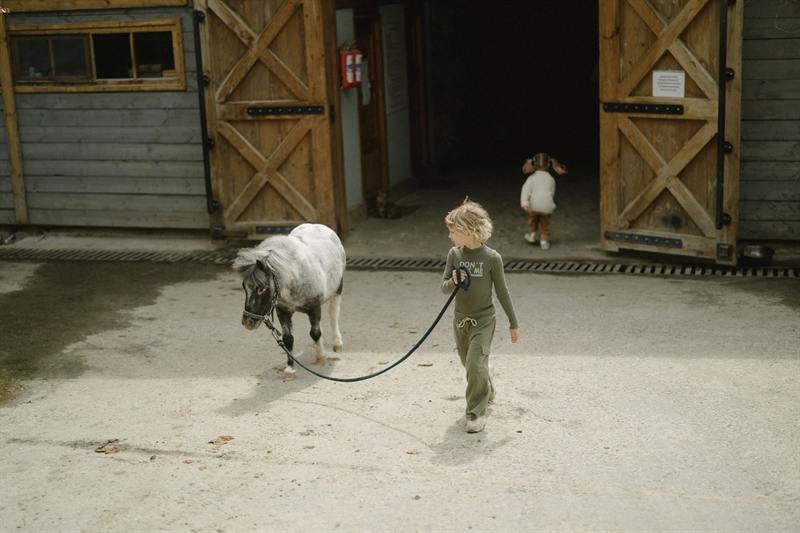
Groundwork games are fun activities you do with your pony on foot, such as leading through an in-hand obstacle course, playing traffic lights or teaching your pony to touch a target. They build a stronger bond, better manners and more confidence for both of you, and they give you something worthwhile to do on days when you can't ride. Here are plenty of game ideas, how to play them safely, and how to set up your own simple course.
Why play games with your pony on the ground?
Lots of time with a pony is spent on the ground: catching, leading, grooming and tacking up. Games turn that time into something you both look forward to, and they quietly teach useful skills along the way.
- Bonding: working together on foot helps you learn how your pony thinks and helps your pony learn to trust you.
- Manners: walking, halting, standing still and backing up on request make your pony safer to handle every day.
- Confidence: meeting new objects calmly in hand, with you beside them, helps ponies cope better with surprises out hacking or at shows.
- Something to do when you can't ride: games are ideal when your pony is too young or too old to ride much, coming back from a rest, or when the weather or ground is unsuitable for riding.
- Your own skills: you learn to read your pony's body language and to give clear, calm signals, which helps your riding too.
These games are lighter and more playful than structured training. If you want the step-by-step basics of leading, yielding and pressure and release, read our groundwork guide first, then come back here to put those skills into games.
Groundwork games to try
Start with the simplest games and only move on when your pony is calm and getting it right. Age is a loose guide: what matters most is a quiet, well-mannered pony and the right level of adult help.
| Game | How to play | Skill it builds | Suits |
|---|---|---|---|
| In-hand obstacle course | Lead your pony round a route of poles, cones, a tarpaulin laid flat and a low, sturdy bridge or board, at walk | Trust, leading and confidence with new things | All ages with adult help; add trickier obstacles for older children |
| Follow my feet | Walk, halt and walk on, trying to get your pony to halt the moment your feet stop, with a loose rope | Leading manners and attention | Beginners upwards |
| Traffic lights in hand | A friend calls green (walk), amber (slow walk) and red (halt) while you lead | Transitions, listening and control | Beginners upwards; great in pairs |
| Back up through an L | Lay poles in an L shape about a metre apart, then back your pony slowly through the gap | Backing up, straightness and precision | Confident children and teenagers |
| Touch the target | Hold out a cone or a soft ball on a stick; when your pony touches it with their nose, reward them, then move the target a little | Focus, curiosity and calm learning | All ages with adult guidance |
| Step-over and yield games | Ask your pony to step their hindquarters away from light pressure, or to step one foot at a time over a single pole | Responsiveness and body awareness | Older children with an experienced adult |
| Leading slalom | Weave in and out of a line of cones at walk, keeping beside your pony's shoulder | Steering in hand and coordination | Beginners upwards |
| Statues | Ask your pony to stand still while you walk slowly around them, starting a short way out and coming closer | Patience and standing calmly | Confident children with an adult holding or nearby |
| Gentle desensitising | Show your pony a streamer, a closed umbrella or a pool noodle at a distance, let them sniff, and slowly build up | Calmness and trust around scary objects | Older children and adults, with an experienced person in charge |
| Agility-style course | Link several obstacles into a timed or judged course, focusing on a loose rope and a willing pony | Putting everything together | Confident handlers with a well-schooled pony |
A note on horse agility
Horse agility is an established activity in which handlers lead or guide their horse or pony around a course of obstacles on foot. Courses often include jumps for the pony, tunnels, bridges, weaving poles and standing still in a box. There are online competitions, where you film your round, and in-person events. It is a lovely goal for children who can't ride much or whose pony is retired from ridden work. Look online for groups and rules near you, and check what equipment and ages they allow before you enter.
Making the desensitising game safe
Never chase a pony with a scary object or hold it over them while they are worried. Let them look, sniff and step away if they need to. Show the object at a distance, reward calm curiosity, and move it closer only when they are relaxed. A short, successful session is far better than pushing too far. For more on building bravery, see confidence and spooking.
Treats and food rewards
Food can be a helpful reward in games, but it needs care. Ponies learn quickly that hands mean treats, and some start nudging pockets, nipping or crowding you. This is often called mugging, and it can turn a sweet pony into a pushy one.
- Keep rewards tiny, such as a single small pony nut or a sliver of carrot, so they don't add much to the diet. Check with whoever looks after your pony's feeding, especially if they are a good doer or prone to laminitis.
- Give treats calmly from a flat hand, never from your fingers.
- Only reward when your pony is standing politely with their head away from you, never when they are nudging or grabbing.
- Use other rewards as well: a rest, a scratch on the withers or a kind word.
- If your pony gets pushy around food, stop using treats for games and ask an experienced adult for help.
Some owners use clicker training or other positive reinforcement methods, where a sound or word marks the exact moment the pony gets it right, followed by a reward. Target games are a common starting point. If you are interested, learn from an experienced person so your timing is good and your pony stays polite.
Staying safe on the ground
Ponies are strong, and even a quiet one can spook or step on a foot. These rules apply to every game.
- Wear the right kit: a correctly fitted riding hat, gloves and sturdy boots. See safety for more.
- Use good equipment: a well-fitting headcollar and a sound lead rope of a sensible length.
- Never wrap the rope around your hand or fingers. Hold it in loose folds so you can let go if you must.
- Adult supervision: children should always play with an adult present who knows the pony.
- A safe space: use a fenced, enclosed area with level, non-slippery footing, gates shut, and other horses and loose dogs kept clear.
- Stand in the right place: walk beside your pony's shoulder, not in front, and keep clear of the hind legs.
- Read body language: ears pinned back, a swishing tail, a high head, wide eyes, snorting or a tense body all mean your pony is worried or unhappy. Stop, make things easier, and give them space. See the horse behaviour section to learn more.
How to set up a simple obstacle course
- Choose your space: pick an enclosed arena or small paddock with good footing and ask permission from the yard owner.
- Gather safe props: ground poles, plastic cones, a tarpaulin or old feed sack, and a low, sturdy board for a bridge. Avoid anything sharp, breakable or likely to blow about.
- Lay out four or five stations: for example, a slalom of cones, a pole to step over, a tarpaulin to walk across, an L of poles to back through, and a box of poles to stand still in.
- Leave plenty of room: space obstacles well apart, with wide turns, and keep a clear exit around anything your pony might find tricky.
- Walk it yourself first: check the route and that nothing can trip either of you.
- Introduce one obstacle at a time: let your pony look and sniff before asking them to go over or through. Praise every small try.
- Link them together: when each part is easy, lead round the whole course at a steady walk with a loose rope.
- Finish on a good note: stop after a calm success, give a scratch, and tidy away the props.
Keep it fun and short
Ten to twenty minutes is usually plenty. Ponies learn best in short sessions, and so do children. Mix easy games your pony already knows with one new challenge, give rests, and stop before anyone gets tired or cross. If your pony seems unusually grumpy, sore or reluctant, stop and tell an adult, as discomfort can show up as bad behaviour. For more ideas, try pony games at home, handy pony or mounted riding games.
FAQs
What games can I play with my pony on the ground?
Popular groundwork games include an in-hand obstacle course, follow my feet, traffic lights, leading slalom, statues, backing through an L of poles and touching a target.
Are groundwork games safe for children?
Yes, with a quiet pony, a hat, gloves and boots, a well-fitted headcollar and lead rope, an enclosed area and an adult supervising at all times.
Can I use treats in groundwork games?
Small, calm rewards can help, but keep them tiny, give them from a flat hand, and stop if your pony starts nudging or nipping for food.
What is horse agility?
It is an activity where you lead your horse or pony round a course of obstacles on foot. There are online and in-person competitions for many ages and abilities.
How long should a groundwork games session last?
Around ten to twenty minutes is normally enough. Keep it short, take breaks and finish on a success.
What if my pony is scared of an obstacle?
Let them stop, look and sniff, make it easier by moving further away, and reward calm interest. Never force or chase a frightened pony.
Do I need special equipment?
No. A headcollar, lead rope, a few poles and cones and a tarpaulin are enough for a great course.
Useful official resources
- The Pony Club Rallies, camps and badges for young riders.
- The British Horse Society Riding safety and approved centres.
- The Highway Code: rules for horse riders (gov.uk) Rules for riding on the road.