
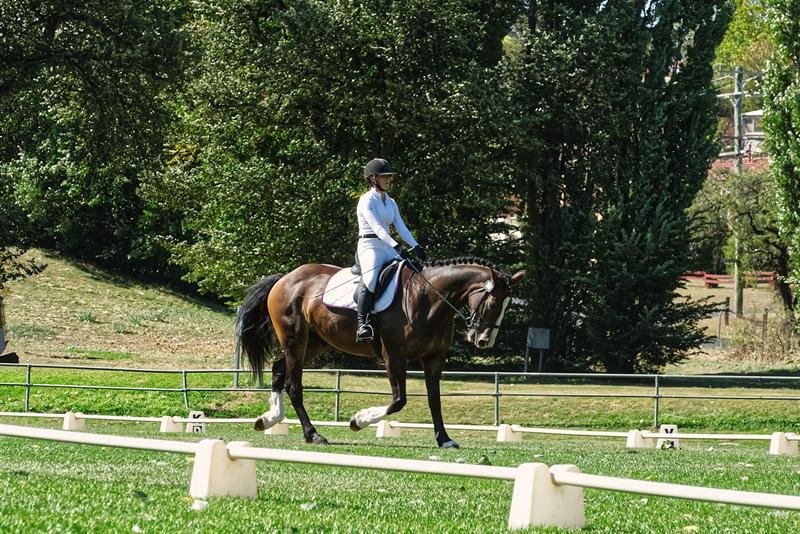
Flatwork exercises for horses are the school figures, transitions and simple movements you ride in an arena or flat field to improve your own accuracy and your horse's balance. This page is the rider's toolkit: the letters, the figures, a session plan and exercises you can use tomorrow. For the horse's long-term development and the training scale, see the training scale and schooling.
Why flatwork matters for riders
Flatwork is the foundation of every discipline. A show jumper needs a balanced, adjustable canter; an event rider needs a supple, obedient horse on the flat; a happy hacker simply enjoys a horse that listens. Ten minutes of purposeful work does more than half an hour of drifting round the track, because you are giving the horse clear questions and rewarding the right answers.
It also shows you your own habits. Most riders are stronger on one rein, collapse a hip, or hold their breath in transitions. Riding accurate figures makes those weaknesses visible, and a good instructor can help you fix them. See riding lessons for advice on finding one.
Know your arena: letters and layout
Standard arenas are 20m x 40m (small) or 20m x 60m (large), marked with letters around the outside. Starting at the entrance (A) and travelling clockwise, the letters on the outside track of a 20m x 40m arena are A, K, E, H, C, M, B, F. The short sides are A and C, and E and B sit in the middle of the long sides. In a large arena, extra letters (V, S, R, W, T, P and others) appear along the long sides, and the centre-line markers D, L, X and I run down the middle.
Learning arena letters lets you ride accurate figures, follow an instructor's directions and read a dressage test sheet. A simple way to learn them is to walk round the arena saying each letter aloud, then ride a circle that touches specific letters. Many riders find it easiest to learn the long-side letters first, then the centre line.
Essential school figures
| Figure | What it teaches |
|---|---|
| 20m circle | Even bend, rhythm and balance; ride a true circle, not an egg |
| 15m and 10m circles | Greater bend, engagement and control of the quarters |
| Serpentine | Changes of bend and straightness on the centre line |
| Figure of eight | Smooth change of bend and rein through two circles |
| Diagonal change of rein | Straightness; riding corners properly before and after |
| Half circles and returns | Quick changes of direction and balance |
Ride corners as part of a circle and look ahead to where you want to be, not down at the horse. Accuracy is the foundation: if you can ride a true 20m circle, almost everything else gets easier.
How to ride a 20m circle
A 20m circle takes up the full width of a 20m x 40m arena, so it touches the track on both long sides. A circle started from A or C is centred halfway between that short end and the middle of the arena, and its widest points touch the fence on each long side. Here is a step-by-step approach.
- Pick your start point, for example A or C, and look at the point where you will touch the opposite side.
- Prepare in the corner before: sit tall, lightly bend the horse around your inside leg, and keep your outside rein steady so the shoulder does not fall out.
- Turn your head and shoulders in the direction of travel. Your eyes lead the horse; if you stare at the ground, the circle will wobble.
- Use your inside leg at the girth to keep the bend and the outside leg slightly behind it to stop the quarters swinging out.
- Keep the rhythm steady. If the horse speeds up or slows down, use half-halts (a brief, subtle rebalancing) rather than pulling.
- Finish the circle where you began, then straighten before the next figure.
Common faults are a flat side where the horse drifts to the fence, cutting the corner, and a horse falling in on the inside shoulder. Check your own position first: an unlevel seat or a dropped inside hip is often the cause.
Exercises that make a difference
- Transitions: walk to trot, trot to halt, trot to canter. Aim for smoothness, with the horse staying round and balanced. Ten good transitions are worth more than a long stretch of trotting round the arena.
- Within-the-gait changes: ask for a few strides of longer trot then shorten again to teach responsiveness.
- Leg yield: moving sideways and forwards away from the leg teaches the horse to respond to your leg and improves suppleness.
- Pole work: trotting poles on the ground improve rhythm and your own balance.
- Riding without stirrups: in moderation, it improves your seat. See riding position.
- Changing rein through the circle: keeps the horse even on both sides and highlights your own one-sidedness.
- Spiral in and out: start on a 20m circle, spiral gradually to about 10m, then leg yield back out. It tests control of the shoulder and quarters.
Plan a 40-minute flatwork session
- Walk (5-10 minutes): on a long rein, then a light contact, to loosen the horse's back.
- Warm-up trot and canter (10 minutes): large figures and gentle transitions on both reins.
- Focus (15-20 minutes): choose one thing to improve, such as downward transitions or a better canter depart, and keep practising.
- Cool-down (5-10 minutes): walk on a long rein to finish on a good note.
Write down what you worked on and what improved. Over a few weeks you will see patterns, such as a horse that is always stiffer to the left, which helps you decide what to practise next.
Schooling without an arena or instructor
You do not need a full-size arena. A flat, safe patch of field or a quiet track works, and you can mark a circle or corners with cones or upturned buckets. Check the ground first: hard, deep or slippery going is not suitable for tight circles or fast work, and keep the exercises gentle if conditions are poor. Filming a session on your phone is a cheap way to check straightness and your own position. Lessons from time to time keep you honest, and many riders also benefit from a mirror or a helper on the ground.
If your horse is resisting
If a horse that normally goes well suddenly resists, naps, falls onto a shoulder, refuses to canter on one rein or becomes tense, rule out discomfort before assuming bad manners. Common culprits are tack that no longer fits, sore feet, teeth and back pain. Ask your vet to check, and have your saddle checked by a qualified saddle fitter. Once pain is ruled out, simplify the work, go back to larger figures and ask for less. See horse control.
Frequently asked questions
What are the best flatwork exercises for beginners?
Start with transitions between walk and trot, 20m circles, changes of rein across the diagonal and simple serpentines. Add trotting poles once you have a steady rhythm.
How often should I do flatwork?
Two or three focused sessions a week are plenty for most horses, mixed with hacking and rest days. Vary your work to avoid boredom.
How long should a flatwork session last?
Around 30 to 45 minutes of ridden time including warm-up and cool-down suits most fit horses. Shorter sessions are better for young, unfit or older horses.
Can I do flatwork without an arena?
Yes. A flat, safe piece of field or a quiet track works, and you can mark figures with cones. Check the ground and keep the work gentle if it is hard or slippery.
Why does my horse find one rein harder?
Most horses and riders are naturally one-sided, like being left- or right-handed. Work both reins equally and spend a little longer on the harder side, but do not overdo it.
What do the arena letters mean?
The letters are simply markers to help you ride accurate figures. Their order is fixed so that riders, instructors and judges all use the same map of the arena.
Useful official resources
- The Highway Code: rules for horse riders (gov.uk) Rules 47 to 58 for riding and leading horses on the road.
- The British Horse Society Riding, safety and access advice.
- British Riding Clubs Training and competition for adult riders.