
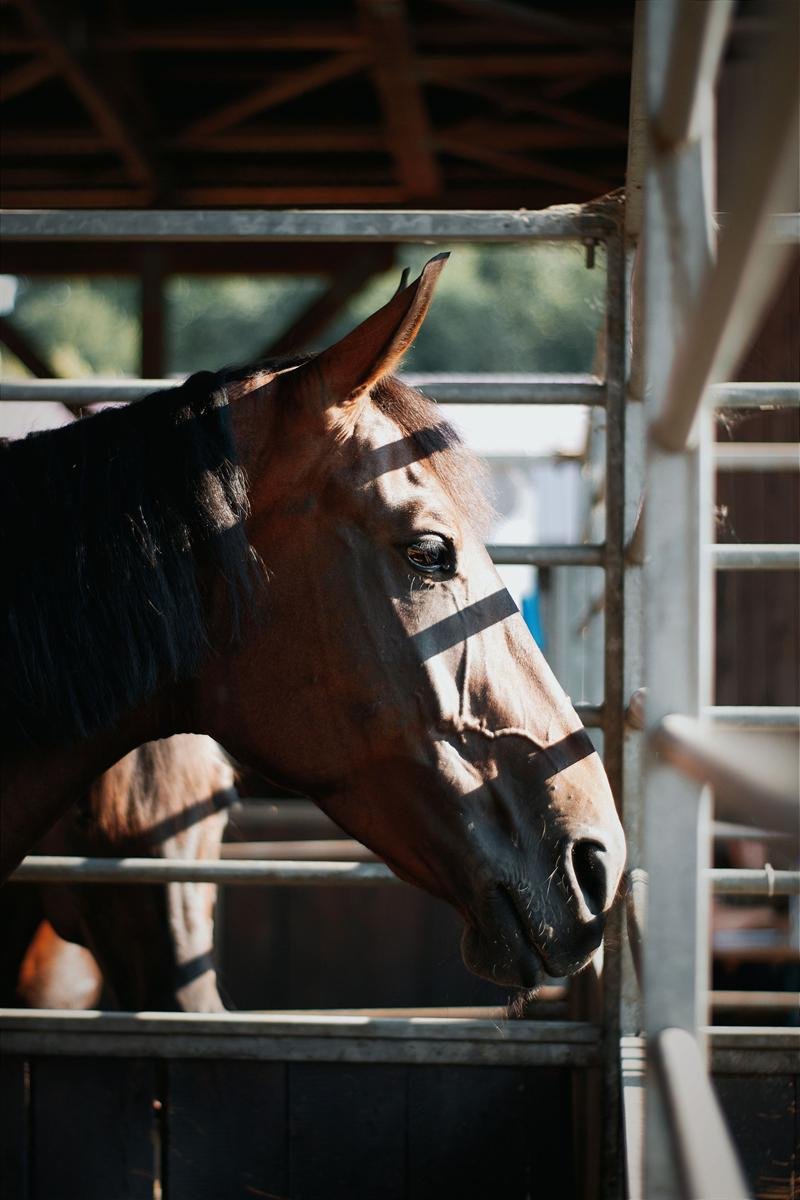
Horse weaving is a repetitive swaying of the head, neck and forehand from side to side, often at the stable door. It is a stereotypic behaviour linked to frustration, confinement, social isolation and anticipation, so the answer to why horses weave is usually the way they are kept. It is rarely fixed by physical barriers alone; changing the horse's lifestyle is what helps.
What is weaving in horses?
A weaving horse shifts its weight from one forefoot to the other, swinging its head and neck, often looking over the door. It typically happens when the horse is stabled, frustrated or anticipating something such as feed or turnout. It may also happen at the field gate or when horses are separated. It is one of the behaviours known as stable vices, though the word "vice" is misleading: it is a coping behaviour, not misbehaviour.
Weaving looks harmless, but it can indicate a stressed horse. Over a long period it may contribute to uneven wear on the legs, weight loss in some horses and difficulty for the horse to rest. Many weaving horses are otherwise healthy and perform well, but the behaviour is a welfare signal worth listening to.
Why do horses weave?
- Long periods in the stable with limited turnout.
- Isolation or lack of visual and physical contact with other horses. See separation anxiety.
- Low forage and high concentrate feeding.
- Frustration around handling, feeding or turnout times.
- Early weaning or stressful life events as a young horse.
- A restricted view of the yard.
- Anticipation, for example when horses are brought in or fed in turn and the weaving horse has to wait.
Some horses seem more prone than others, and a behaviour that began for one reason can continue as a habit even after the cause has gone. That is why early action matters.
Rule out pain and health issues first
Any change in behaviour deserves a thought about pain. Ask your vet to check the horse if weaving is new, if it has become more intense, or if the horse is losing weight or seems uncomfortable. Gastric ulcers, dental problems, and aches in the legs or back can add to a horse's stress and restlessness. A health check also gives you a baseline, so you can tell whether management changes are making a difference.
How to stop a horse weaving: practical changes
- Increase turnout. The more time out, with a companion, the better. Daily turnout is the single biggest change for many horses.
- Improve the social set-up. Stable the horse next to a friend, with a grille or partition they can see through. Consider moving the stable closer to yard action.
- Review the diet. Provide ad-lib forage in small-holed nets or multiple piles, and reduce starchy feed. See hay.
- Use calm routines. A predictable feeding and turnout schedule reduces anticipation.
- Exercise and variety. Regular, varied work helps burn off excess energy.
- Consider the environment. A larger or double-sized stable or a "stable with a view" can reduce frustration. See stable design.
Weaving by situation: what to try
| When it happens | Likely driver | What to try |
|---|---|---|
| Before feed | Anticipation or hunger | More forage, a gentler feed routine |
| When other horses leave | Separation distress | Turn out in pairs, stable near a friend |
| At the stable door all day | Boredom, confinement | More turnout, a view, foraging toys |
| When people walk past | Frustration, attention seeking | Predictable handling, more exercise |
| At the field gate | Wanting to join others or come in | Review group dynamics and routine |
| At shows or in new stables | Stress in an unfamiliar place | Allow settling time, bring forage, stable near others |
Do anti-weave grilles work?
Anti-weave grilles and bars, which restrict head movement, may stop the behaviour at the door, but a horse often finds another outlet, such as box-walking. They are best seen as a short-term measure while you change management, not a cure. A V-shaped or open design allows the horse to see out and look around, and some owners find they reduce the movement a great deal, but they do not meet the needs that drive it. If you are thinking of fitting a grille, talk to your vet, and make sure it does not restrict the horse's ability to look out or cause injury. Never rely on physical restraint while the horse's environment stays the same.
Weaving and welfare, soundness and sale
There is no firm evidence that weaving by itself causes lameness, but the repetitive movement may add stress to joints, so discuss it with your vet if your horse is otherwise sore. See lameness. Weaving may affect a horse's value and must be declared honestly when selling. On the welfare side, a horse that weaves is telling you that something in its life is not working, and improvements in turnout, company and forage are likely to benefit its overall health.
Weaving when the horse cannot be turned out
Sometimes turnout is limited by injury, weather, laminitis risk or yard rules. In that case, try to give the horse as much of what turnout provides in other ways. Hand-graze or walk the horse in hand each day, offer several hay nets at different heights, rotate safe enrichment items, and make sure it can see and touch a friend. Ask your vet or a qualified equine behaviourist for a plan if the horse is on long-term box rest. See recovery.
Can weaving be cured?
Many weaving horses improve a great deal when their management is changed, and some stop altogether when they live out with company. A horse that has weaved for years may continue at a lower level, especially when excited, stabled or waiting for feed. The realistic aim is to reduce the behaviour to a minimum and give the horse a life where it does not need it. If the horse is still distressed despite good management, ask your vet to refer you to a qualified equine behaviourist.
Frequently asked questions
Will my horse stop weaving if turned out all the time?
Many weaving horses improve dramatically with 24-hour turnout and company, though a long-established habit may continue at a lower level, especially when excited.
Is weaving contagious?
Not strongly. It is mainly driven by the horse's own environment.
Does weaving affect soundness?
There is no firm evidence it causes lameness, but the repetitive movement may add stress to joints, so discuss it with your vet if your horse is otherwise sore. See lameness.
Why does my horse weave when I leave?
It is often separation distress or frustration. Company, more turnout and a calm routine usually help.
Is weaving cruel to the horse?
The behaviour itself is a coping mechanism, and what matters is the cause. A horse that weaves is showing that its needs are not fully met, so improve its environment as far as you can.
Do I have to declare weaving when selling a horse?
Yes. Be honest about any stable vice. See selling a horse.
Useful official resources
- World Horse Welfare: advice Behaviour and welfare guidance.
- RCVS Find a Vet Rule out pain with an equine vet.
- British Horse Society: horse care and welfare Handling and behaviour advice.