
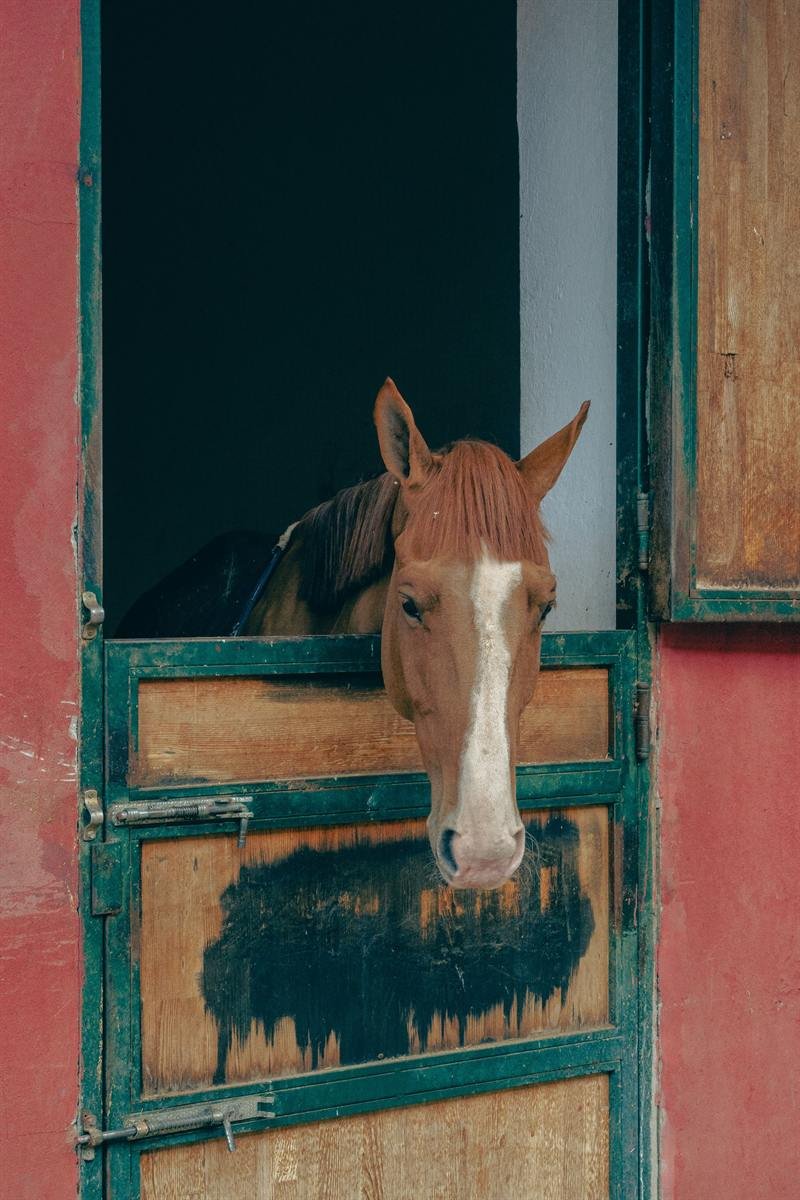
Stable vices in horses is an old term for what behaviour scientists call stereotypic or abnormal repetitive behaviours, such as crib-biting, weaving and box-walking. They are not vices or naughtiness. They are coping behaviours that tend to appear when a horse's natural needs for foraging, movement and company are not being met, so the most effective response is to change the horse's management, not to punish it.
What counts as a stable vice?
| Behaviour | What the horse does |
|---|---|
| Crib-biting | Grasps a solid object with the teeth and pulls back, often with a gulping sound |
| Weaving | Sways the head, neck and forehand from side to side, shifting weight between front legs |
| Box-walking | Walks repeatedly around the stable |
| Wood-chewing | Chews fences, doors and stable woodwork; often linked to a lack of fibre |
| Door-kicking and pawing | Repeatedly kicks or paws, often at feed time or when restricted |
| Tongue-rolling and head-nodding | Repetitive movements without an obvious purpose |
A stereotypy is a repeated, fixed behaviour with no clear purpose. A one-off bout of pawing at feed time is normal. A horse that does the same thing for hours, or cannot easily be distracted from it, is showing a stereotypy.
What causes stable vices?
Research and welfare guidance consistently link stereotypic behaviours to management: limited turnout, long periods without forage, low-fibre, high-concentrate diets, social isolation, early weaning and stressful transitions. Some horses may be more genetically or temperamentally prone, so two horses on the same yard may react differently. Once established, the behaviour may become habitual and persist even when the original stress is gone.
Think of it from the horse's point of view. Horses evolved to graze for much of the day, to move constantly and to live in groups. A horse that is shut in a stable for most of the day, fed a few large meals and cut off from its companions has a lot of unspent motivation. A repetitive behaviour is one way of coping with it.
How to reduce stable vices: step by step
- Forage, forage, forage. Provide ad-lib or near-constant access to hay or haylage, in slow-feeding nets where needed. Reduce concentrate feed. See hay.
- More turnout. Maximise time out, ideally in company. Even a few extra hours help.
- Companions. Allow physical contact, or at least over a fence or through a partial wall. Stable horses facing each other tend to be calmer.
- Environment. Provide a clear view of yard activity, good ventilation and a regular routine. See stable design.
- Exercise and enrichment. Appropriate daily exercise, varied work and safe objects to forage.
- Medical check. Ask your vet about gastric ulcers or dental disease, which are associated with some behaviours. Ruling out pain comes first.
Which change helps which behaviour?
| Behaviour | Common drivers | First changes to try |
|---|---|---|
| Crib-biting | Low forage, high starch, gut discomfort | More forage, vet and dental check, more turnout |
| Weaving | Frustration, isolation, confinement | Company, turnout, view of the yard |
| Box-walking | Stress, separation, anticipation | Turnout, forage, predictable routine |
| Wood-chewing | Lack of fibre, boredom | More hay, safe chew options, turnout |
| Door-kicking | Anticipation, frustration | Feed routine, forage, company |
What does not help
Punishing, muzzling or restricting a horse physically might suppress the movement but not the underlying need, and can raise stress. Anti-vice equipment, such as collars, grilles and bars, is controversial on welfare grounds and should not replace changes to management. If you are considering any such device, discuss it with your vet first. Some people believe horses copy each other, but evidence suggests most vices develop because of management rather than being "caught", so isolating a vice-horse should not be the first response. Isolation can make the problem worse.
Are stable vices a welfare problem?
Yes, they are best seen as a welfare indicator. A horse showing stereotypic behaviour is telling you something about its environment. Some behaviours also carry physical consequences, such as worn incisors from crib-biting, wear on joints from weaving or box-walking, and weight loss in horses that spend a lot of energy on the behaviour. Many affected horses are otherwise healthy and perform well, but that does not mean the behaviour should be ignored. The earlier you act, the easier it is to prevent it becoming habitual.
Prevention: keeping a horse's needs met
- Give as much time at grass as possible, ideally with companions.
- Base the diet on fibre and keep starchy feeds to what the horse needs. See hard feed.
- Avoid long gaps without forage, particularly overnight.
- Wean foals gradually and with company, and plan stressful changes (moving yards, travel, box rest) with extra support.
- Keep routines predictable, and give variety in work.
- Buy a horse that suits the type of yard and lifestyle you can offer.
Living with a horse that has a stable vice
If your horse already has an established vice, aim for progress rather than perfection. Keep a simple record of when the behaviour happens and what you have changed, so you can see what is working. Make one change at a time where possible, give it a few weeks, and then review. Involve everyone who cares for the horse, from yard staff to your vet, so that the routine stays consistent. Tell your insurer, livery yard and anyone sharing the horse about the behaviour, and check that your yard can offer the turnout, forage and company the horse needs. Where a horse has a physical consequence, such as worn teeth or weight loss, ask your vet and an equine dental technician to monitor it. See dental care.
Stable vices and buying or selling a horse
A stable vice can affect value and suitability, and it must be disclosed honestly when selling. When buying, ask direct questions, see the horse in its stable as well as being ridden, and discuss anything you notice with the vet at the vetting. See vetting and selling a horse. A horse with a vice may suit a yard that offers plenty of turnout and company, but not every situation, so be realistic about the lifestyle you can provide.
Frequently asked questions
What are stable vices in horses?
They are repetitive behaviours such as crib-biting, weaving, box-walking and wood-chewing. Scientists call them stereotypies, and they usually reflect unmet needs for forage, movement and company.
Do other horses copy vices?
It is commonly believed, but evidence does not strongly support copying as the main route. Management is usually the key factor.
Can stable vices be cured?
Often they can be reduced a great deal, but a long-established habit may remain at a lower level, especially when the horse is excited or stressed.
Do vices affect sale value?
They can, and they must be declared honestly when selling. See selling a horse.
Should I use a grille or collar to stop a vice?
These devices are controversial and treat the symptom rather than the cause. Discuss any device with your vet and change management first.
Why does my horse chew wood?
Often it is a lack of fibre or boredom. Offer more hay, longer turnout and safe things to chew, and ask your vet to check for gut or dental issues.
Useful official resources
- World Horse Welfare: advice Behaviour and welfare guidance.
- RCVS Find a Vet Rule out pain with an equine vet.
- British Horse Society: horse care and welfare Handling and behaviour advice.