
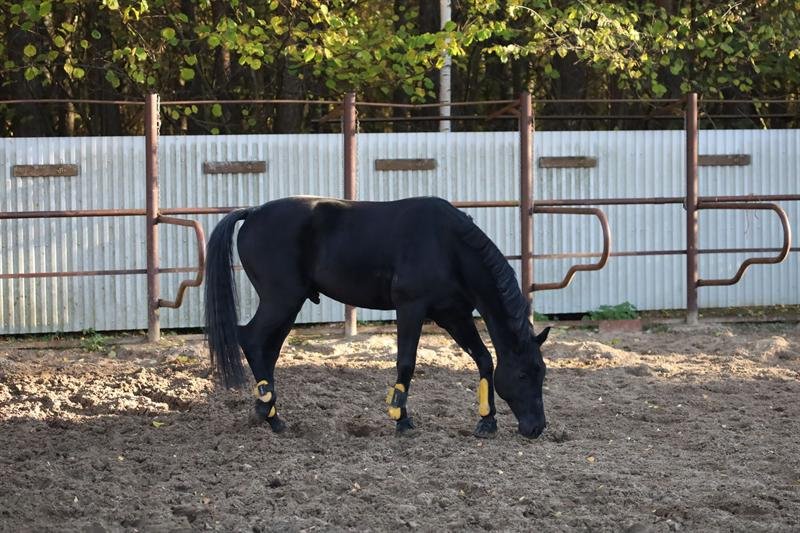
Horse bandages support, protect and keep legs and wounds clean, but poorly applied ones can damage tendons, so they are worth learning to do properly. Always use padding beneath, keep the tension even and never bandage over a swollen or hot leg without advice from your vet.
Types of horse bandage
- Stable bandages: thick, soft wraps used with padding to keep legs warm, support circulation and protect after work.
- Exercise bandages: elasticated and stretchy, used in work; need expertise because they can restrict movement or cause pressure.
- Polo wraps: fleece wraps that fasten with hook-and-loop, easy to apply for flatwork or turnout in some settings.
- Tail bandages: help keep the tail neat during travel; must never be left on for long as they risk cutting circulation.
- Cohesive or vet wraps: self-adhesive, used over dressings in first aid. See first aid kits.
- Travel bandages: stable-style bandages with padding, sometimes used to protect legs on a journey. Many owners prefer travel boots, which are quicker and more consistent to fit.
Polo wraps vs bandages
Owners often ask whether to use polo wraps or traditional bandages. Both can protect and support, but they are used differently, and neither is automatically better.
| Feature | Stable bandage | Exercise bandage | Polo wrap |
|---|---|---|---|
| Main use | Warmth, support and protection at rest | Light support or protection in work | Protection in work or travel |
| Padding needed | Yes, always | Yes, always | Often used with or without a thin liner, follow the maker's advice |
| Stretch | Low | Elastic, so tension is easy to get wrong | Some stretch |
| Skill needed | Moderate | High | Moderate |
| Risk if applied badly | Pressure marks or uneven support | Tendon pressure and restricted movement | Rubbing, slipping or uneven pressure |
| Washing | Easy | Easy | Easy, but dry fully |
Many riders choose boots instead of wraps for work because they are easier to fit consistently. You can compare options in our horse boots guide.
How to bandage a horse leg
This is a general method for a stable bandage. If you have never done one, ask an experienced person or instructor to show you in person first.
- Pick clean, dry padding (gamgee or quilt) cut to fit the leg, from just below the knee or hock to below the fetlock.
- Wrap the padding around the leg once, smoothing it flat, with the join to the outside.
- Start the bandage at the top, just below the knee or hock, with a little of the end tucked under.
- Wrap downwards, overlapping by half the width each turn, keeping the tension firm and even.
- Go down to the fetlock, then back up, finishing just below the start with the tapes or Velcro on the outside of the leg.
- Check the bandage lies flat, tapes are tied securely and nothing is too tight at the tendons.
Bandage both legs, front or hind, in pairs, so support is even. Do not leave one leg bandaged alone unless advised by your vet.
Common bandaging mistakes
- Too tight: the most common error. Pressure over the tendons can cause lasting damage. If you can barely slide a finger under, it is too tight.
- Uneven tension: a bandage that is tight in places and loose in others creates pressure points.
- No padding: bandaging straight onto the leg concentrates pressure.
- Tapes over the tendon: fastenings should sit on the outside of the leg, tied or fastened flat.
- Wet bandages: they shrink as they dry and can tighten on the leg.
- Leaving bandages on too long: remove them regularly so you can check for rubs, swelling or heat.
- Bandage slipping: a loose bandage can slide down and trip the horse, so make sure it is secure but not tight.
Exercise bandages and stable bandages
Exercise bandages are a skilled job. They are elastic, so tension can build as the horse works and the leg warms up. Some trainers use them for specific reasons, but they are not a substitute for fitness and sound training, and many riders prefer boots. If you want to use them, ask an experienced instructor to supervise until you are confident.
Stable bandages are more forgiving, and are commonly used after work or on a horse who needs warmth or gentle support. They can also be used to hold a poultice or dressing in place, but if there is a wound, call your vet before you bandage it. See our first aid guide for what to do in an emergency.
When are bandages used?
Common reasons include keeping legs warm and comfortable after work, protecting legs in the stable or on a journey, holding a dressing or poultice in place on a vet's advice and supporting a leg during recovery when your vet recommends it. Bandages are not a cure for lameness or a way of masking a problem, and they should never replace a proper diagnosis. If you are not sure why you are using one, ask your vet or an experienced instructor.
What to look for when buying
- Width and length suited to your horse: usually 4 to 5 inches wide and long enough for two full turns.
- Soft, breathable materials that wash well.
- Good-quality padding in matching pairs, never cut too short.
- Secure but safe fastenings, preferably Velcro that releases rather than tapes that can be over-tightened.
- Sets of four, so you can swap if one gets wet.
- Spare padding, since it wears and flattens.
Care and maintenance
Wash bandages after use, drying them fully and rolling them neatly, ready to apply. Wet or muddy bandages can chafe and cause skin trouble, such as mud fever. Check padding for compression and replace flat or worn pieces. Remove bandages every day to inspect legs and re-apply fresh ones. Roll bandages with the fastening on the outside so they are ready to use, and store them somewhere dry, clean and out of the reach of rodents.
FAQs
Can I leave stable bandages on overnight?
Often yes, if applied correctly with padding, but check them in the morning and never leave them on if the leg looks puffy or the horse is uncomfortable.
Are exercise bandages safer than boots?
Not necessarily. They need more skill to apply and can cause damage if wrong. Boots are generally easier and more consistent.
Do bandages prevent injuries?
They provide limited support and protection, but they do not replace good fitness, schooling and soundness.
What is the difference between polo wraps and bandages?
Polo wraps are fleece strips that fasten with Velcro and are usually used for protection in work, while stable bandages are used with padding for warmth and support at rest. Follow the manufacturer's guidance for each.
How tight should a horse bandage be?
Firm and even, but not tight. The padding should be smooth and flat, and you should be able to slide a finger under the top edge without forcing it.
Should I bandage a horse's leg if it is swollen?
Not without asking your vet first. A swollen leg may need cold treatment or investigation, and a bandage can hide or worsen a problem.
Useful official resources
- Society of Master Saddlers Find qualified saddle and bridle fitters.
- BETA The British Equestrian Trade Association.
- British Horse Society: horse care and welfare Care advice for horse owners.