
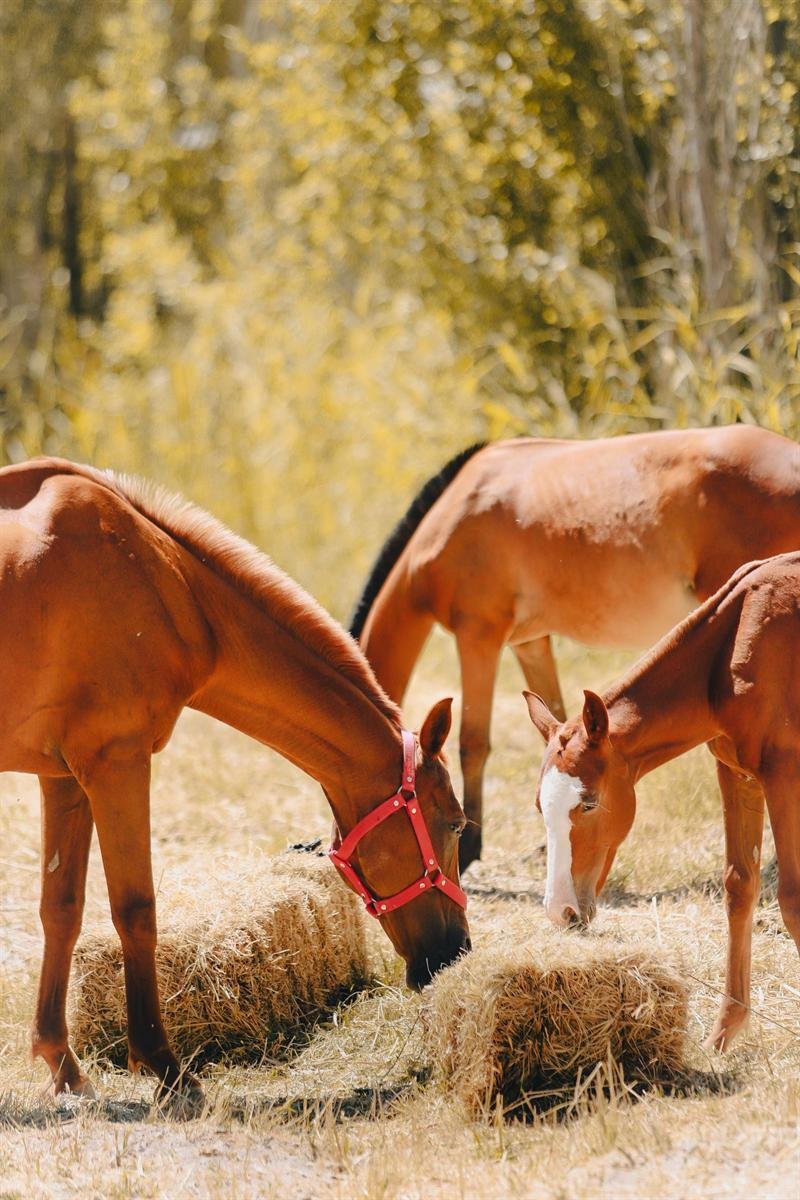
A horse hay net keeps forage off the floor, reduces waste and, with smaller holes, slows eating so a horse has something to chew for longer. Choose a net of the right size and mesh for your horse, tie it with a quick-release knot, and hang it high enough that a hoof cannot get caught when it empties.
Net types and mesh sizes
- Standard nets: holes about 5 to 6 cm across, easy to fill, quicker to eat from.
- Small mesh hay nets: holes around 3 to 4 cm, helpful for slowing greedy eaters and reducing waste.
- Very small mesh nets: holes of around 2.5 cm or less, which slow eating a great deal but can frustrate some horses.
- Double nets: a small-hole net inside a standard one, for even slower feeding.
- Haylage nets: often larger and made to hold the denser, more compact forage.
- Rigid slow feeders and boxes: sit on the floor or hang on the wall, with grids to slow intake.
Hole sizes vary between makes, so use the figures above as a guide only.
Slow feed hay nets: who they suit
A slow feed hay net lets a horse eat little and often, which is closer to the way horses are designed to graze. It can help horses prone to laminitis, those who need to lose weight, and horses that get bored or stressed without something to chew. It can also cut waste, because less hay gets pulled out and trampled.
Not every horse suits very small holes. Introduce them gradually, watch that your horse is eating comfortably and make sure he does not go for long periods without forage, since long gaps are not good for the gut. Very fine nets can also wear on the teeth, so ask your vet or equine dental technician if you have concerns. For some horses, a gradual move from a standard to a small-hole net is the kindest option.
Hay net sizes and capacity
Nets come in small, standard and large sizes. A typical large net holds around 5 to 8 kg of hay, depending on how tightly it is packed. Weigh your hay at first to see what actually goes in. Match the net to your horse's daily ration: overfilling makes a net heavy and drooping, while underfilling lets it hang loosely and tangle with feet. Haylage is heavier and denser than hay, so a net holding a given weight of hay will hold less haylage by volume.
Think too about whether you want one big net or several smaller ones. Several smaller nets let you spread the forage around the stable or field, and encourage natural movement. They are also easier to lift and fill.
How to hang a hay net safely
- Choose a strong tie ring or fixture that is firmly attached, not a loose rail or a flimsy fitting.
- Tie the net to the ring with a quick-release knot, using the string at the top.
- Hang it so the bottom of the net, even when empty, is clear of the ground. A common rule is at least as high as the horse's elbow or above, with the net tied up tight to the wall, so a hoof cannot get through the holes or loops.
- Pull the drawstring tight and tuck the loose ends away so they cannot loop round a leg.
- Check the net often as it empties and drops, and re-tie it if needed.
The exact height is a judgement for you and your yard, but the rule of thumb is simple: the lower a net hangs when empty, the greater the risk. Some owners prefer a hay rack, a hay bar or a floor-level feeder because they remove the problem entirely.
Materials and construction
- Knotted netting: traditional polypropylene or polyester, very common and strong.
- Knotless netting: smoother, gentler on teeth and lips, and less likely to snag.
- Cord thickness: thicker cords last longer and are easier to grip; very thin ones can cut into the hands and wear quickly.
- Draw rope: a soft, thick rope that ties easily and does not slip.
Look for materials with UV stabilisers if the net is used outside, as sunlight weakens cheap netting.
What to look for when buying
- Strong, knotted or stitched netting that will not unravel.
- An appropriate hole size for your horse's habits and ration.
- A thick, soft draw rope that is easy to tie.
- Weather-resistant material if hanging outdoors.
- Suitable for your forage, whether hay or haylage.
- Enough durability to withstand chewing and pulling.
- A size that matches your daily ration and your lifting ability.
Care and maintenance
Empty and shake out nets regularly, and wash them to remove mould, dust and slobber. Dry thoroughly before reuse. Mend holes at once, and replace nets with frayed strands or broken knots. If you soak hay for your horse, a wet net is heavy and stretches, so wring it out and dry it before reuse. Read our guide to hay to decide whether to soak or steam. Never feed mouldy hay from a net, and check that the netting does not hold old, damp forage in the bottom.
Filling and managing hay nets
Fill nets loosely enough that your horse can pull out a mouthful without struggling, but tightly enough that hay does not drop out as soon as it is lifted. Weigh the hay for the first few fills so you know exactly how much your horse is getting; this matters especially for horses on a restricted diet. Shake out the hay as you fill, to remove dust, and keep the net clean at the bottom where old stalks collect. Many horses stabled for long periods do best with forage available most of the time, so plan how often to refill, and give your horse something to eat overnight.
Alternatives to hay nets
Hay nets are not the only way to feed forage. Hay racks, hay bars, haynet-style slow feeders, floor feeders with grids and open stable floors are all used. Floor feeding is closer to natural grazing posture and avoids the dangers of hanging nets, though it may waste more hay and can be dirtier. A hay bar or corner feeder can be a safe option for a horse that dislikes nets or who has dental trouble. Ask your vet or nutritionist for advice if your horse has particular health needs. Our stable equipment guide covers other stable fittings.
FAQs
How high should I hang a hay net?
Hang it so the bottom is well clear of the ground when empty, at least above elbow height, and tie it up tight. The lower it hangs, the greater the risk of a leg getting caught.
Are small-hole nets better for every horse?
No. They suit horses that need slow feeding but can frustrate some. Observe how your horse copes and introduce them gradually.
What size hole is best for a slow feeder?
Holes of roughly 3 to 4 cm are a common starting point. Go smaller only if your horse manages comfortably.
How often should I wash hay nets?
Whenever they look dirty or smell off, and always if used for soaked hay.
Can I use a hay net in the field?
Yes, but secure it carefully at a safe height and check it daily. Some owners prefer a ground feeder in the field.
How much hay does a net hold?
A large net often holds roughly 5 to 8 kg of hay, but this varies with the net and how tightly it is packed.
Useful official resources
- Society of Master Saddlers Find qualified saddle and bridle fitters.
- BETA The British Equestrian Trade Association.
- British Horse Society: horse care and welfare Care advice for horse owners.