
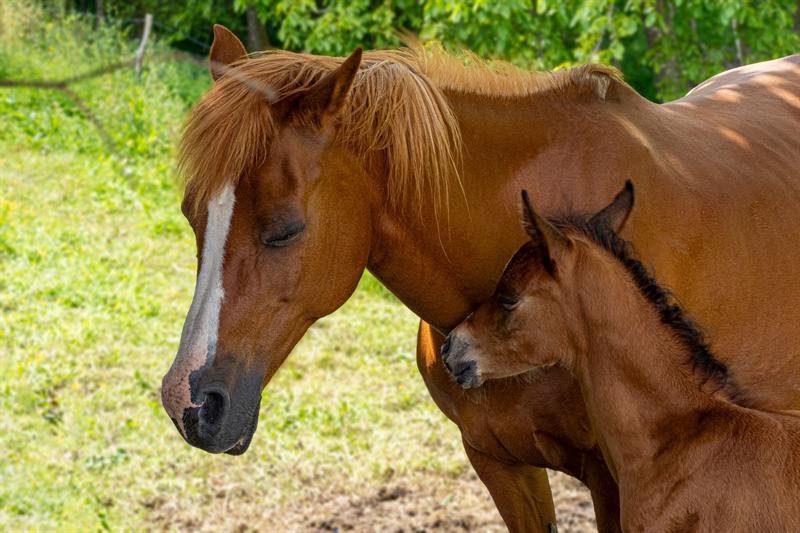
Foal feeding starts with colostrum: a healthy foal gets everything it needs from its dam in the first weeks, provided it receives colostrum early and the mare is well fed. From a few weeks it begins nibbling forage, and by weaning the focus is a balanced diet for steady, not rapid, growth. Overfeeding is more common, and more damaging, than underfeeding.
Colostrum for foals: the first hours
Colostrum, the first milk, carries antibodies the foal needs because it is born with almost none. A foal should stand and suckle within roughly the first couple of hours, and your vet will typically check antibody levels (IgG) in the first day or two to confirm that enough have been absorbed. The foal's gut can absorb antibodies only for a short window after birth, so delay matters. A foal that is not suckling, or a mare that has not passed the placenta, is an emergency; see foal care.
What to feed a foal in the first weeks
For the first few weeks, milk is the main nutrition. Foals typically suckle frequently, many times an hour at first. Mare's milk supply depends on her diet, so lactating mares usually need more energy, protein, calcium and phosphorus than at any other stage, with good forage as the base and a balanced stud feed or balancer as advised by a nutritionist; see mare care. A foal in good condition is bright, active, growing and has regular, soft droppings. If the mare has little milk, rejects the foal or the foal is orphaned, call your vet at once for advice on milk replacers and fostering; do not try home recipes.
Introducing solids
- Foals usually begin nibbling hay, grass and the mare's feed within the first weeks.
- Offer access to forage and, if the mare is on hard feed, a safe place to eat away from mare disputes, or a specific foal feed placed where only the foal can reach.
- Use feed formulated for foals and growing horses, with balanced calcium, phosphorus, copper, zinc and quality protein.
- Introduce changes gradually, and monitor for loose droppings: so-called foal heat diarrhoea is common, but any severe or prolonged scour needs a vet.
Creep feeding foals
Creep feeding means offering a foal its own feed in an area the mare cannot reach, usually a gap or feeder only a foal can fit into. It can help where the mare's milk or grass is poor, where the foal is growing fast, or to accustom the foal to eating concentrate before weaning, which eases the transition. It is not essential for every foal, and used carelessly it can encourage overly rapid growth. Offer small amounts of a feed designed for foals, remove leftovers, and ask a nutritionist whether your foal needs it at all. Foals that gorge on creep feed can develop gut upsets.
Feeding foals at weaning
Many foals are weaned at around four to six months, with a gradual, low-stress method preferred where possible, such as group weaning with a calm older companion. Before weaning, let the foal get used to eating its own feed so the transition is a change in company, not in food. Keep the diet consistent in the days around weaning and keep an eye on appetite, because stress can reduce eating. See young horses for handling and early education.
Growing on after weaning
After weaning, youngstock should be fed for steady growth, with good forage, a balanced feed or balancer formulated for growing horses and consistent bodyweight checks. Rapid growth from excess energy is linked to developmental orthopaedic disease, where bones and joints develop abnormally. Rather than pushing growth, aim for a lean-ish, well-muscled youngster, with correct mineral balance, because a diet lacking in copper or zinc, or with a poor calcium and phosphorus balance, can also lead to problems. Weigh or weigh-tape regularly and record growth, but do not rely on a tape alone as it is inaccurate in very young animals.
Foal feeding checklist
| Stage | Main food | Key points |
|---|---|---|
| First hours | Colostrum | Suckling soon after birth; vet checks antibody transfer |
| First weeks | Mare's milk | Feed the mare well; watch for scour |
| From a few weeks | Milk plus forage | Foal begins to nibble hay, grass and feed |
| Before weaning | Milk, forage, foal feed | Teach the foal to eat its own feed |
| After weaning | Forage plus balanced feed | Steady growth, regular checks, no excess energy |
Quantities depend on breed type, expected adult size, forage quality and the mare, so ask a stud feed company or an independent nutritionist to work them out rather than copying a figure from another yard.
Forage and grazing for mares and foals
Good forage is the foundation for both mare and foal. Pasture quality changes through the year, and lush spring grass can be very rich, while poor late-summer or winter grazing may leave a lactating mare short. Watch the mare's body condition as well as the foal's: a mare that loses too much weight while feeding may need extra feed, and one that becomes very fat is also at risk. Provide clean water at all times, because lactating mares drink a lot. Foals graze alongside the mare and learn what to eat from her, so keep her feed and forage clean, fresh and free from mould. Check that fencing, field hazards and shelter are safe for a small foal; see pasture care.
Worming, dental care and the foal's gut
A foal's gut is still developing, so sudden diet changes are risky. Worm control in young animals is a veterinary matter and should be planned with your vet or a suitably qualified person, because foals are particularly susceptible to some parasites; see worms. Foals also benefit from early, routine checks of teeth, feet and conformation. A foal that is eating poorly, dribbling feed or losing condition may have a dental, gut or illness problem that no change of feed will fix.
Common feeding mistakes with foals
- Feeding too much concentrate to produce a big, fast-growing youngster.
- Using adult or mare feed at random, which may have the wrong balance of minerals and protein for growth.
- Adding extra mineral or vitamin supplements on top of a balanced feed without checking the total.
- Making sudden changes at weaning, when the foal is already under stress.
- Ignoring body condition and growth between the foal's first and second year.
Frequently asked questions
When do foals start eating hay?
Often from the first few weeks, copying the mare, though milk remains the main food at first.
What should I feed a foal?
Mostly its dam's milk, then forage and a feed designed for foals or growing horses once it begins to eat, with advice from a vet or nutritionist.
Does a foal need creep feed?
Not always. It is helpful where the mare's milk or grass is poor, or to prepare for weaning; ask a nutritionist.
Can I feed a foal the mare's feed?
Not routinely: mare feeds may not be balanced for a growing foal.
Why is colostrum so important for foals?
The foal is born with almost no antibodies and gets them from colostrum in a short window after birth. Without them it is at high risk of infection.
How can I tell if my foal is growing too fast?
Signs include a heavy, overly fat appearance, swollen joints or limbs that look crooked. Call your vet and review the diet with a nutritionist.
Useful official resources
- World Horse Welfare: advice Body condition scoring and feeding guidance.
- British Equine Veterinary Association The professional body for equine vets.
- Code of Practice for the Welfare of Horses (gov.uk) Legal standards for feeding and care.