
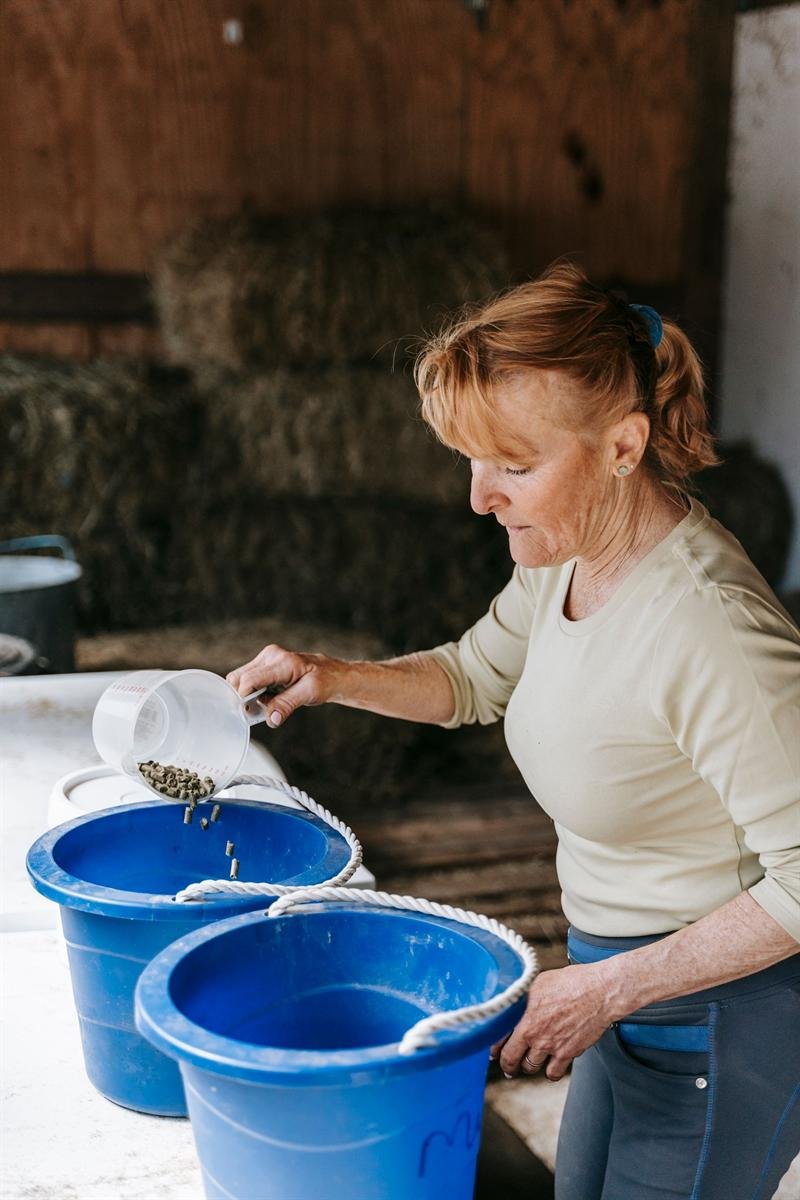
A horse feeding chart shows roughly how much a horse should eat each day: most adult horses eat about 1.5 to 2.5 per cent of their bodyweight in dry matter, mostly as forage, which is around 8 to 13kg of hay as fed for a 450kg horse. These tables are general guides only. Every horse is an individual, so adjust to body condition and check with your vet or an equine nutritionist before making changes, particularly for horses with laminitis, insulin dysregulation, PPID or weight problems.
Step 1: Work out bodyweight
Use a weighbridge if you can, or a weigh tape taken consistently (snug, behind the elbow, on the exhale). Tapes are least accurate for cobs, natives, very young horses and heavily pregnant mares, so treat them as a way to track trends. Add a condition score: a horse in ideal condition can be fed to its current weight, while an overweight or thin horse is fed for a target weight, changing gradually.
Step 2: How much forage per day does a horse need?
The widely accepted range is 1.5-2.5% of bodyweight in dry matter a day. The table converts that into approximate hay as fed, assuming hay is about 85% dry matter. Haylage, which is wetter, needs around 25-35% more as fed.
| Bodyweight | Dry matter at 1.5% | Dry matter at 2% | Dry matter at 2.5% | Hay as fed (1.5%-2.5%) |
|---|---|---|---|---|
| 200kg (small pony) | 3.0kg | 4.0kg | 5.0kg | 3.5-5.9kg |
| 350kg (13-14hh pony or cob) | 5.3kg | 7.0kg | 8.8kg | 6.2-10.3kg |
| 450kg (15hh horse) | 6.8kg | 9.0kg | 11.3kg | 7.9-13.2kg |
| 550kg (16hh horse) | 8.3kg | 11.0kg | 13.8kg | 9.7-16.2kg |
| 650kg (large horse) | 9.8kg | 13.0kg | 16.3kg | 11.5-19.1kg |
Good-doers and those needing to slim are towards the lower end (never below 1.5% without vet advice); thin, hard-working or cold-stressed horses towards the upper end. Pasture counts: a horse on abundant grass may need no hay at all, and grazing intake is hard to measure.
Step 3: Adjust for workload
Forage is the foundation of every ration. Work, age and condition decide how much extra feed, if any, sits on top of it.
| Workload | Example | Typical approach |
|---|---|---|
| Maintenance or very light | Retired, or a few walks a week | Forage only (around 1.5-2% of bodyweight), plus a balancer and salt if needed |
| Light | Hacking and a little schooling, 3-4 days a week | Mostly forage, with a balancer or small amount of low-energy feed |
| Moderate | Regular schooling, local competitions | Forage at 1.5-2% plus 1-3kg a day (as directed on the bag) of a suitable compound feed, split into small meals |
| Hard | Eventing, endurance, racing | Forage still at least 1.5%, plus more energy from fibre and oil; get a tailored ration from a nutritionist |
The concentrate figures above vary widely with the type of feed and the horse. Always follow the label's feeding guide and cut back if the horse becomes overweight or excitable.
Example ration for a 500kg leisure horse
As an illustration only, a 500kg horse in light work might need around 7.5 to 10kg of dry matter a day, which is roughly 9 to 12kg of hay as fed. If he also has a few hours of grass, the hay can be reduced, but you should reduce it gradually and watch his weight and condition. A small portion of balancer, following the label, covers vitamins and minerals without adding many calories. Many horses also benefit from a measured amount of salt in the diet. See hay and haylage for how the two forages differ.
Adjusting for age, condition and type
- Good-doers and natives: often thrive on the lower end of the range and are prone to weight gain and laminitis. See weight loss.
- Thin or hard-working horses: may need the upper end and more energy-dense feed. See weight gain.
- Older horses: may need softer or more digestible feed if their teeth are poor, see senior feeding.
- Youngsters, pregnant and lactating mares: have special needs, so ask your vet or nutritionist for a tailored plan.
- Cold weather: horses burn more energy staying warm, so check condition regularly and increase forage rather than hard feed first.
Putting it into practice
- Weigh a typical net or slice of hay on hanging scales, so you know what you're feeding.
- Split the forage over the day, avoiding gaps of more than about four hours.
- Add concentrates only if forage doesn't meet condition and workload needs.
- Make any change over 7-10 days, and recheck weight and condition every two to four weeks.
- Record the ration, so you can adjust with the seasons.
Feeding little and often
The horse's stomach is small and produces acid all the time, so he is designed to eat small amounts almost continuously. Long gaps without forage increase the risk of gastric problems and can lead to boredom and stable vices. Aim to keep forage in front of a stabled horse for most of the day, using small-holed nets or slow feeders to stretch it out, and split any hard feed into small meals of no more than about 2kg each, as directed on the label. Turnout with grazing, where suitable, is the most natural way of meeting this need. Always provide fresh, clean water and consider salt, particularly in summer.
Signs you are feeding the right amount
- You can feel his ribs easily with light pressure but cannot see them clearly.
- He has a smooth outline along the neck, back and quarters, without fat pads or a prominent crest.
- He has steady energy suited to his work, not flat or excitable.
- His droppings are well formed and he eats his forage with appetite.
If any of these change, review the ration with your vet or nutritionist rather than guessing.
Horse feed calculators: what they can and cannot do
Online and manufacturer feed calculators are useful for a first estimate, but they rely on you entering accurate weight, workload and forage details. They cannot see your horse. Treat their output as a starting point and compare it with your horse's actual condition. If he is gaining or losing weight faster than you want, change the ration rather than trusting the calculator. For complicated cases, a registered equine nutritionist or your vet can balance a ration properly.
FAQs
How much should a horse eat per day?
Typically 1.5-2.5% of bodyweight in dry matter, mostly forage. That is roughly 8-13kg of hay as fed for a 450kg horse.
How many kilos of hay does a 500kg horse need?
Roughly 9-14kg as fed for the full 1.5-2.5% range, with many leisure horses needing around 9-11kg, subject to grazing and condition.
Do ponies need less?
They need less in absolute terms, but similar proportions of bodyweight; many natives need the lower end.
Does haylage weigh more than hay?
Haylage is wetter, so you generally need around 25-35% more as fed to supply the same dry matter.
How often should I weigh my horse?
Every two to four weeks is a sensible habit, using the same tape and method each time.
Are these figures suitable for laminitic ponies?
Not without your vet's advice. They may need soaked or low-sugar forage and tailored plans. See laminitis.
Useful official resources
- World Horse Welfare: advice Body condition scoring and feeding guidance.
- British Equine Veterinary Association The professional body for equine vets.
- Code of Practice for the Welfare of Horses (gov.uk) Legal standards for feeding and care.