
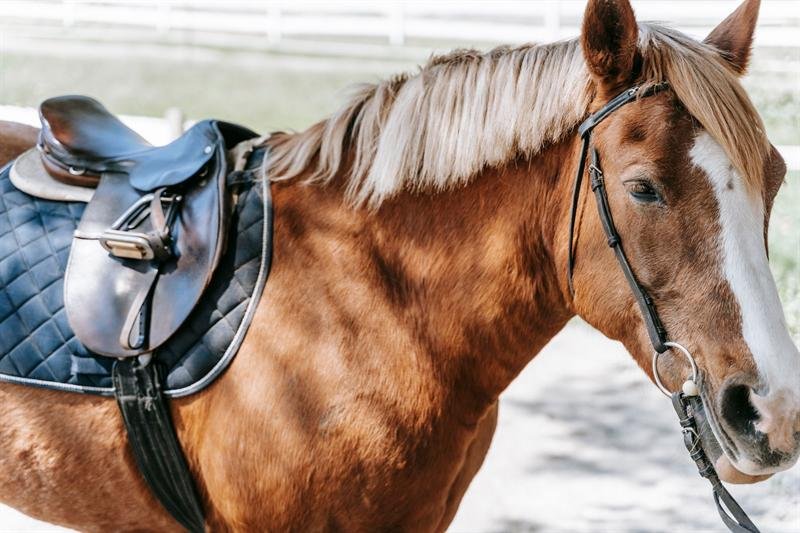
Horse girths are the straps that hold your saddle in place under the belly, and the right one is the correct length for your horse, a shape that suits his build and a soft, breathable material that avoids rubbing. Measure carefully, check the fit each time you tack up and ask a qualified saddle fitter if your horse seems uncomfortable.
What a girth does
A girth buckles to the billets on each side of the saddle and passes around the horse just behind the elbows. It keeps the saddle stable without restricting breathing or the movement of the elbows and shoulders. Because it sits over a sensitive area, with thin skin, nerves and large muscles nearby, a poor girth can cause pain, rubbing and even behaviour such as cold-backed reactions, nipping when tacked up or reluctance to go forward.
Types of girth
| Type | Description | Often used for |
|---|---|---|
| Straight | Same width the whole length, simple and traditional | General riding, showing |
| Shaped or contoured | Curved to clear the elbows and allow movement | Jumping, eventing, sensitive horses |
| Short dressage girth | Short, with buckles clear of the saddle flaps | Dressage saddles with short flaps |
| Elastic-ended | Elastic at one or both ends for give | Horses that dislike being tightened |
| Fleece, neoprene or padded | Soft covers over the main strap | Sensitive skin, clipped horses |
| String or cord | Open weave, lets air through | Summer, warm-blooded horses |
| Anatomic or stud-guard | Special designs with extra space or protection | Cross-country, horses with large chests |
Short dressage girths
Many dressage saddles have short flaps and a short girth to avoid bulk under the rider's leg. Short girths are not interchangeable with ordinary girths, because they attach to girth straps that are specific to the saddle. They typically buckle to shorter billets and need to be the right length so the buckles sit at a sensible height. A short girth can also be hard to measure if you are not sure what size you need, so ask your saddle fitter or the retailer. See saddles for how the saddle itself affects girth choice.
How to measure for a girth
The best method is to measure the girth you already have, if it fits well, from end to end of the buckle holes on the biggest strap. If you do not have one, use a soft tape.
- Tack up your horse with the saddle on, without the girth, and make sure the saddle is sitting correctly.
- Drop a piece of string or a soft tape from the billet on one side, around the belly, just behind the elbow, and back to the billet on the other side.
- Note the length in inches, then compare it to the retailer's size chart.
- Leave room for adjustment. The buckles should sit about midway on the billets, with some holes left either side.
- Check the girth with the horse standing square, as the barrel can look different in a horse that is holding his breath.
Girth sizes
Girths are usually sold in 2-inch steps, for example 42, 44 or 46 inches for general girths, with shorter ones for ponies and longer for large horses. Common pony sizes may start around 30 inches and adult horse sizes commonly range from the mid 40s up to the 50s. Dressage girths are a different scale, often 20 to 30 inches. Because sizes vary between makers, always use the specific chart. Horses change shape with fitness, grass and the seasons, so you may need more than one size over the year.
Choosing the right shape for your horse
A horse with a deep, rounded barrel and little room behind the elbow often does best with a shaped or anatomic girth that curves away from the elbows. A narrow or slab-sided horse may do well in a straight girth. Horses that are sensitive, thin-skinned or clipped can benefit from a soft lining. If you see your horse resist at the girth, change the girth only after you have checked the saddle fit and ruled out pain.
Materials
- Leather: strong, smart and long lasting, but needs regular cleaning and conditioning.
- Synthetic and neoprene: easy to wash and quick to dry, though some horses sweat more under them.
- Fleece or sheepskin: soft against the skin and good for sensitive horses; wash regularly.
- Cotton or string: breathable and light but can be harder to keep clean.
Girth galls and rubbing
Girth galls are sore, sometimes broken areas of skin behind the elbows, caused by friction, pressure, sweat or dirt. Prevent them by keeping the girth clean and soft, tightening gradually, checking the skin after riding and ensuring there are no creases or hard edges. If you see hair loss, swelling, scabs or raw skin, stop riding until it heals. Wounds should be cleaned and checked, and a persistent problem might mean the girth shape, the saddle fit or the horse's weight needs looking at.
How to fit and tighten a girth safely
- Fasten the girth loosely enough that you can slide your fingers under it.
- Tighten it by a hole or two at a time, ideally over a few minutes or after a short walk.
- Pull each front leg forward to smooth the skin under the girth.
- Check again once you have mounted and have been riding for a few minutes.
Over-tightening can restrict breathing and cause discomfort, which some horses react to by pulling faces, swelling the belly or moving off. If your horse reacts, ask your vet to rule out pain and a qualified saddle fitter to check the saddle and girth. Our saddle fitters directory can help.
What to look for when buying
- The right length with room to adjust on both sides.
- A soft, breathable lining without hard seams near the elbows.
- Strong buckles and stitching, with elastic that still has stretch.
- A shape suited to your horse's chest and your discipline.
- A fastening that matches your saddle's billets.
- A design that is simple to wash or wipe clean.
Expect to pay roughly £20–£150 for a girth in 2026, depending on material and type, varying by region and retailer.
FAQs
How tight should a girth be?
Snug enough that the saddle cannot slip, but not so tight that your horse cannot breathe or you cannot slide your fingers beneath. Tighten in stages.
How do I know if my girth is the wrong size?
If the buckles sit at the top holes on one or both sides, or the girth is so loose that you reach the lowest holes, it needs a different size.
Can I use a long girth with a short dressage saddle?
Usually not. Dressage saddles with short flaps are designed for short girths, because long buckles would sit under your leg.
How often should I wash my girth?
Wipe or wash after every use, particularly synthetic and fleece types, and give leather a thorough clean and condition weekly.
Why does my horse pull faces when girthed up?
It can be learned behaviour, but it can also signal pain from ulcers, back problems, a poor girth or an ill-fitting saddle. Ask your vet to check.
Useful official resources
- Society of Master Saddlers Find qualified saddle and bridle fitters.
- BETA The British Equestrian Trade Association.